
Journal of Shanghai University >
High-performance Li-ion hybrid capacitor with metal organic framework-derived porous carbon nanomaterial and lithium titanate
Received date: 2019-04-19
Online published: 2019-05-14
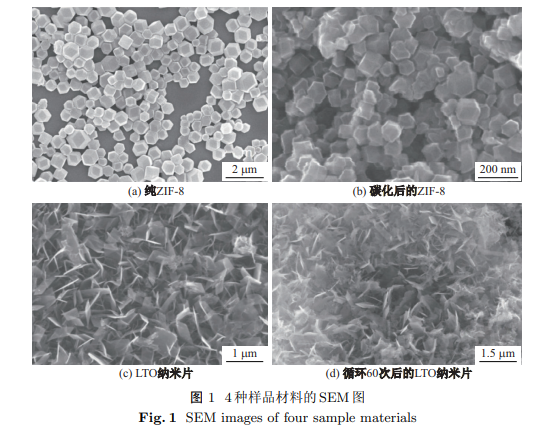
Li-ion hybrid capacitors, which combine the high energy densities of Li-ion batteries and high power densities of super capacitors, are a new type of energy storage device with large application potentials. In this study, a porous carbon nanomaterial (carbonized zeolitic imidazolate framework-8 (cZIF-8)) derived from metal organic frameworks (MOFs) was synthesised by pyrolysis of a MOF precursor at a high temperature. This carbon material had a large specific surface area, excellent porosity, good thermal stability, and high conductivity. A new type of Li-ion hybrid capacitor (cZIF-8//lithium titanate (LTO)) was constructed using a capacitor electrode based on cZIF-8 as a positive electrode and battery electrode based on LTO as a negative electrode. The assembled device had highest energy density of 44 W·h·kg-1 and power density of 5387 W$\cdot$kg$^{-1}$, significantly higher than that of a cZIF-8//cZIF-8 supercapacitor (16.6 W·h·kg-1). The Li-ion hybrid capacitor (cZIF-8//LTO) also exhibited a good cyclic performance (85.4% of the initial value after 10000 cycles) at a high current density of 2 A·g-1. This MOF-based Li-ion hybrid capacitor enables to effectively increase the energy density of the electrochemical energy storage device without reducing the power capability.
Weiwei YAO , Jian MAO , Chen ZHANG , Zhen LI , Minghong WU . High-performance Li-ion hybrid capacitor with metal organic framework-derived porous carbon nanomaterial and lithium titanate[J]. Journal of Shanghai University, 2020 , 26(6) : 963 -971 . DOI: 10.12066/j.issn.1007-2861.2143
| [1] | Getman R B, Bae Y S, Wilmer C E, et al. Review and analysis of molecular simulations of methane, hydrogen, and acetylene storage in metal-organic frameworks[J]. Chemical Reviews, 2012,112(2):703-723. |
| [2] | Dong M J, Zhao M, Ou S, et al. A luminescent Dye@MOF platform: emission fingerprint relationships of volatile organic molecules[J]. Angewandte Chemie: International Edition, 2014,53(6):1575-1579. |
| [3] | Jiang H L, Feng D, Liu T F, et al. Pore surface engineering with controlled loadings of functional groups via click chemistry in highly stable metal-organic frameworks[J]. Journal of the American Chemical Society, 2012,134(36):14690-14693. |
| [4] | Gao X T, Liu Y T, Zhu X D, et al. V$_2$O$_5$ nanoparticles confined in three-dimensionally organized, porous nitrogen-doped graphene frameworks: flexible and free-standing cathodes for high performance lithium storage[J]. Carbon, 2018,140:218-226. |
| [5] | Kim Y, Han H, Noh Y, et al. Honeycomb-like nitrogen-doped carbon 3D nanoweb@Li2S cathode material for use in lithium sulfur batteries[J]. Chemsuschem, 2019,12(4):824-829. |
| [6] | Gao M, Liu X W, Yang H, et al. FeP nanoparticles derived from metal-organic frameworks/GO as high-performance anode material for lithium ion batteries[J]. Science China: Chemistry, 2018,61(9):1151-1158. |
| [7] | Chaikittisilp W, Hu M, Wang H, et al. Nanoporous carbons through direct carbonization of a zeolitic imidazolate framework for supercapacitor electrodes[J]. Chemical Communications, 2012,48(58):7259-7261. |
| [8] | Young C, Salunkhe R R, Tang J, et al. Zeolitic imidazolate framework (ZIF-8) derived nanoporous carbon: the effect of carbonization temperature on the supercapacitor performance in an aqueous electrolyte[J]. Physical Chemistry Chemical Physics, 2017,19(33):22596. |
| [9] | Liu B, Shioyama H, Akita T, et al. Metal-organic framework as a template for porous carbon synjournal[J]. Journal of the American Chemical Society, 2008,130(16):5390-5395. |
| [10] | Wu H B, Xia B Y, Yu L, et al. Porous molybdenum carbide nano-octahedrons synthesized via confined carburization in metal-organic frameworks for efficient hydrogen production[J]. Nature Communications, 2015,6:6512. |
| [11] | Kim H, Park K Y, Cho M Y, et al. High-performance hybrid supercapacitor based on graphene-wrapped Li$_4$Ti$_5$O$_{12}$ and activated carbon[J]. Chemelectrochem, 2014,1(1):125-130. |
| [12] | Kaftelen H, Tuncer M, Tu S, et al. Mn-substituted spinel Li$_4$Ti$_5$O$_{12}$ materials studied by multifrequency EPR spectroscopy[J]. Journal of Materials Chemistry A, 2013,1(34):9973-9982. |
| [13] | Yu J, Mu C, Yan B Y, et al. Nanoparticle/MOF composites: preparations and appli-cations[J]. Materials Horizons, 2017,4(4):557-569. |
| [14] | Zou F, Chen Y M, Liu K W, et al. Metal organic frameworks derived hierarchical hollow NiO/Ni/graphene composites for lithium and sodium storage[J]. Acs Nano, 2016,10(1):377-386. |
| [15] | Jain A, Aravindan V, Jayaraman S, et al. Activated carbons derived from coconut shells as high energy density cathode material for Li-ion capacitors[J]. Scientific Reports, 2013,3:6. |
/
| 〈 |
|
〉 |
