
收稿日期: 2018-09-26
网络出版日期: 2021-06-27
基金资助
江苏省自然科学基金资助项目(BK20161361)
Improved single neuron gradient learning-based active queue management for wireless networks
Received date: 2018-09-26
Online published: 2021-06-27
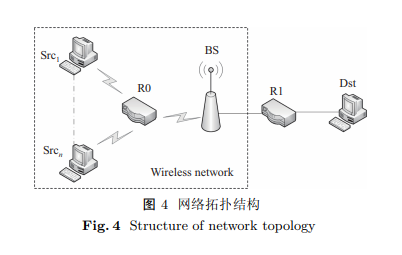
考虑传统网络拥塞控制忽略了网络拥塞的持续状态, 引入将数据包到达链路速率作为控制器输入的方案, 得到一种改进单神经元梯度学习(improves single neuron gradient learning, ISNGL)的主动队列管理算法. ISNGL 算法采用梯度学习动态调整网络参数, 并在此基础上对收敛速度和稳定性加以改进, 提出带有位移参数的新激活函数和带有权值调整的动量项的改进方法, 最后通过 NS2 网络仿真软件在无线网络的拓扑模型上进行仿真分析, 结果表明 ISNGL 算法在无线网络环境下拥有良好的拥塞控制能力.
戚爱春, 徐磊 . 基于改进单神经元梯度学习的无线网络主动队列管理[J]. 上海大学学报(自然科学版), 2021 , 27(3) : 553 -562 . DOI: 10.12066/j.issn.1007-2861.2172
This study introduces a scheme that takes the packet arrival link rate as the input of the controller, where the traditional network congestion control ignores the continuous state of network congestion. Then, an active queue management algorithm that improves single neuron gradient learning (ISNGL) is obtained. The algorithm uses gradient learning to adjust dynamically the network parameters and to improve the convergence rate and stability. The study also proposes a new activation function with displacement parameters and an improved method using momentum adjustment for weights. Finally, NS2 network simulation software is used to simulate a wireless network topology model. Results show that the ISNGL algorithm provides good congestion control capability in wireless networks.
| [1] | Feng C W, Huang L F, Xu C, et al. Congestion control scheme performance analysis based on nonlinear RED[J]. IEEE Systems Journal, 2017,11(4):2247-2254. |
| [2] | Ko N S, Kim M H, Park H S. FD-AQM: fairness-aware delay-controlled active queue management in 802.11s-based multi-radio multi-channel wireless mesh networks[J]. IEEE Communications Letters, 2015,19(5):839-842. |
| [3] | Miquel T, Condomines J P, Chemali R, et al. Design of a robust controller/observer for TCP/AQM network: first application to intrusion detection systems for drone fleet[C]// Proceedings of the 2017 IEEE/RSJ International Conference on Intelligent Robots and Systems. 2017: 1707-1712. |
| [4] | Boudi A, Loudini M. Active queue management exploiting the rate information in TCP-IP networks[J]. IEEE/CAA Journal of Automatica Sinica, 2018,5(1):223-231. |
| [5] | Akashdeep, Kahlon K S, Kaushal M. Analysis of a queue length aware and latency guaranteed fuzzy-based adaptive resource allocator for WiMAX networks[J]. Optik, 2016,127(1):357-367. |
| [6] | Liu Z, Sun J, Hu S, et al. An adaptive AQM algorithm based on a novel information compression model[J]. IEEE Access, 2018,6:31180-31190. |
| [7] | Xiao K, Mao S, Tugnait J K. MAQ: a multiple model predictive congestion control scheme for cognitive radio networks[J]. IEEE Transactions on Wireless Communications, 2017,16(4):2614-2626. |
| [8] | Mohammadi M R, Sadrossadat S A, Mortazavi M G, et al. A brief review over neural network modeling techniques[C]// Proceedings of the IEEE International Conference on Power, Control, Signals and Instrumentation Engineering. 2017: 54-57. |
| [9] | Cordero J A. Multi-path TCP performance evaluation in dual-homed (wired/wireless) devices[J]. Journal of Network and Computer Applications, 2016,70:131-139. |
| [10] | Li F, Sun J, Zukerman M, et al. A comparative simulation study of TCP/AQM systems for evaluating the potential of neuron-based AQM schemes[J]. Journal of Network and Computer Applications, 2014,41:274-299. |
| [11] | Zheng F, Nelson J. An $H_{\infty }$ approach to congestion control design for AQM routers supporting TCP flows in wireless access networks[J]. Computer Networks, 2007,51(6):1684-1704. |
/
| 〈 |
|
〉 |
