
收稿日期: 2019-03-06
网络出版日期: 2019-04-16
基金资助
国家自然科学基金资助项目(11575107)
Effects of different ZnO nanoparticles on ion absorption in human gastric epithelium cells
Received date: 2019-03-06
Online published: 2019-04-16
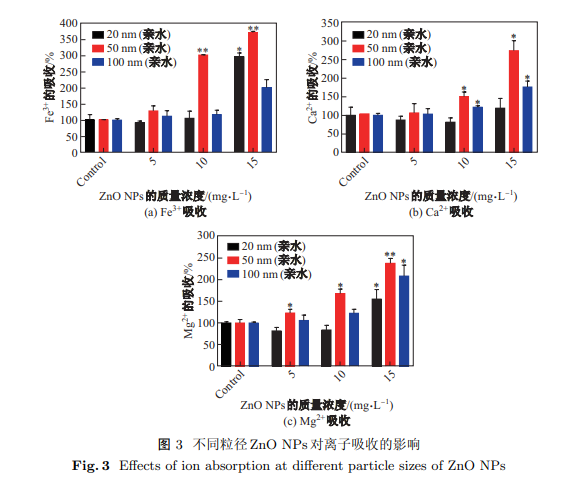
研究了不同种类低浓度ZnO纳米颗粒(nanoparticles, NPs)对人胃黏膜上皮细胞(gastric epithelium cells-1, GES-1)吸收Fe$^{3+}$, Ca$^{2+}$和Mg$^{2+}$的影响. 结果表明: ZnO NPs对Fe$^{3+}$吸收浓度的影响最为显著; 3种离子的浓度变化与ZnO NPs的粒径和质量浓度有关, 其中50 nm的ZnO NPs对离子吸收的影响最大, 且在ZnO NPs质量浓度为15 mg/L时细胞的离子吸收浓度达到最高; ZnO NPs的亲水和亲油特性对离子吸收无明显影响. 最后, 通过检测与不同种类ZnO NPs共同培养的GES-1的细胞活力以及活性氧(reactive oxygen species, ROS)水平, 对影响离子吸收的机理进行了讨论.
王咪咪 , 吴明红 , 王艳丽 . 不同种类的ZnO纳米颗粒对人胃黏膜上皮细胞离子吸收的影响[J]. 上海大学学报(自然科学版), 2021 , 27(4) : 696 -705 . DOI: 10.12066/j.issn.1007-2861.2170
This paper systematically studied the effects of different types and low concentrations of ZnO nanoparticles (NPs) on the uptake of Fe$^{3+}$, Ca$^{2+}$ and Mg$^{2+}$ in human gastric epithelium cells-1 (GES-1). The results showed that ZnO NPs had the most significant impact on the absorption of Fe$^{3+}$. The changes in the three ion concentrations in GES-1 were related to the size and concentration of ZnO NPs. Among them, the effect of 50 nm ZnO NPs on the absorption of ions was the most significant, reaching the highest concentration at 15 mg/L. However, the hydrophilic and lipophilic properties of ZnO NPs had no obvious effect on the absorption of ions. Finally, the mechanism of ion adsorption was discussed by detecting the cell viability and reactive oxygen species (ROS) levels of different types of ZnO NPs.
Key words: ZnO nanoparticles (NPs); size; concentration; ion absorption
| [1] | Mirzaei H, Darroudi M. Zinc oxide nanoparticles: biological synjournal and biomedical applications[J]. Ceramics International, 2017, 43(1):907-914. |
| [2] | Smijs T G, Pavel S. Titanium dioxide and zinc oxide nanoparticles in sunscreens: focus on their safety and effectiveness[J]. Nanotechnology Science and Applications, 2011(4):95-112. |
| [3] | Perez E, Paula J, Ferreira S, et al. ZnO nanoparticles: synjournal, antimicrobial activity and food packaging applications[J]. Food and Bioprocess Technology, 2012, 5(5):1447-1464. |
| [4] | Bolognesi C, Castle L, Cravedi J P, et al. Safety assessment of the substance zinc oxide, nanoparticles, for use in food contact materials[J]. EFSA Journal, 2016, 14(3):20164408. |
| [5] | Wang Y L, Yuan L L, Yao C J, et al. Caseinophosphopeptides cytoprotect human gastric epithelium cells against the injury induced by zinc oxide nanoparticles[J]. RSC Advance, 2014, 4(79):42168-42174. |
| [6] | Liang T S, Guan R F, Tao M, et al. In vitro toxicity of zinc oxide nanoparticles from food additives in human gastric epithelium (GES-1) cells[J]. Science of Advanced Materials, 2017, 9(8):1393-1400. |
| [7] | Wang Y L, Yuan L L, Yao C J, et al. A combined toxicity study of zinc oxide nanoparticles and vitamin C in food additives[J]. Nanoscale, 2014, 6(24):15333-15342. |
| [8] | Go M R, Yu J, Bae S H, et al. Effects of interactions between ZnO nanoparticles and saccharides on biological responses[J]. International Journal of Molecular Sciences, 2018, 19(2):020486. |
| [9] | Mahler G J, Esch M B, Tako E, et al. Oral exposure to polystyrene nanoparticles affects iron absorption[J]. Nature Nanotechnology, 2012, 7(4):264-271. |
| [10] | Ryazanova L V, Rondon L J, Zierler S, et al. TRPM7 is essential for Mg$^{2+}$ homeostasis in mammals[J]. Nature Communications, 2010, 1:109. |
| [11] | Guo Z Y, Martucci N J, Moreno-Olivas F, et al. Titanium dioxide nanoparticle ingestion alters nutrient absorption in an in vitro model of the small intestine[J]. NanoImpact, 2017(5):70-82. |
| [12] | Ognik K, Stepniowska A, Cholewinska E, et al. The effect of administration of copper nanoparticles to chickens in drinking water on estimated intestinal absorption of iron, zinc, and calcium[J]. Poultry Science, 2016, 95(9):2045-2051. |
| [13] | 王宁, 刘丹, 谢敏伟, 等. 水环境中纳米氧化锌的环境行为及生物毒性研究进展[J]. 环境化学, 2016, 35(12):2528-2534. |
| [13] | Wang N, Liu D, Xie M W, et al. Behavior and toxicity of zinc oxide nanoparticles in aquatic environment[J]. Environmental Chemistry, 2016, 35(12):2528-2534. |
| [14] | Reshma V G, Mohanan P V. Cellular interactions of zinc oxide nanoparticles with human embryonic kidney (HEK 293) cells[J]. Colloids and Surfaces B (Biointerfaces), 2017, 157:182-190. |
| [15] | Sembratowicz I, Ognik K, Stepniowska A. A evaluation of in vitro intestinal absorption of iron, calcium and potassium in chickens receiving gold nanoparticles[J]. British Poultry Science, 2016, 57(4):559-565. |
| [16] | Hara H, Onoshima S, Nakagawa C. Difructose an hydride Ⅲ promotes iron absorption in the rat large intestine[J]. Nutrition, 2010, 26(1):120-127. |
| [17] | Mortimer M, Kasemets K, Kahru A. Toxicity of ZnO and CuO nanoparticles to ciliated protozoa tetrahymena thermophila[J]. Toxicology, 2010, 269:182-189. |
| [18] | Espinoza A, Le B S, Olivares M, et al. Iron, copper, and zinc transport: inhibition of divalent metal transporter 1 (DMT1) and human copper transporter 1 (hCTR1) by shRNA[J]. Biological Trace Element Research, 2012, 146(2):281-286. |
| [19] | Salovaara S, Sanderg A, Andlid T, et al. Organic acids influence iron uptake in the human epithelial cell line Caco-2[J]. Journal of Agricultural and Food Chemistry, 2002, 50(21):6233-6238. |
/
| 〈 |
|
〉 |
