Based on the linear theory of potential flow, the propagation characteristics
of ocean-based hydro-acoustic waves (also known as acoustic-gravity waves) are studied
through the use of an elastic plate model to simulate an ocean-surface ice sheet, where the
seawater is regarded as an inviscid compressible fluid with a rigid bottom. Approximate
solutions for the displacement at the ice-water interface and the acoustic pressure in the
ice-covered ocean under the pulsation of a single mass point source are derived. The effects
of the thickness and lateral stress of the elastic ice sheet and the depth of fluid on the
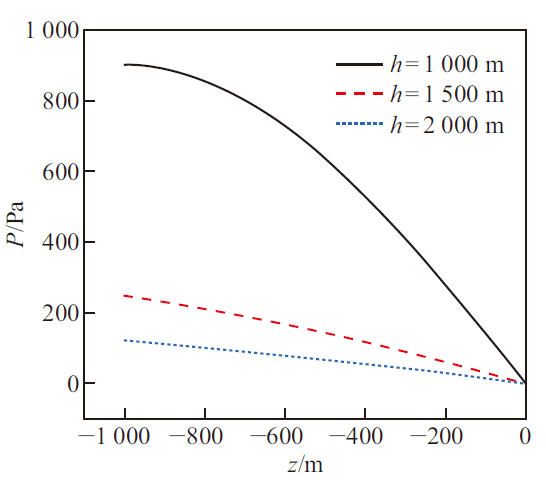
propagation of the hydro-acoustic waves are discussed. Results show that with the gradual
increase in elastic ice sheet thickness, the displacements at the ice-water interface first increase, then decrease, and finally gradually approach zero, whereas the acoustic pressure
of the ice-covered ocean initially remains unchanged and then gradually decreases. The
lateral stress of the elastic ice sheet has little effect on both the displacement and acoustic
pressure. With the increase in the depth of fluid, both the displacement and acoustic
pressure tend to decrease.
YAN Xiangyi1, 2 , LU Dongqiang1, 2, 3, 4
. Propagation characteristics of the hydro-acoustic waves
due to an oscillating source in an ice-covered ocean[J]. Journal of Shanghai University, 2024
, 30(5)
: 938
-950
.
DOI: 10.12066/j.issn.1007-2861.2607

