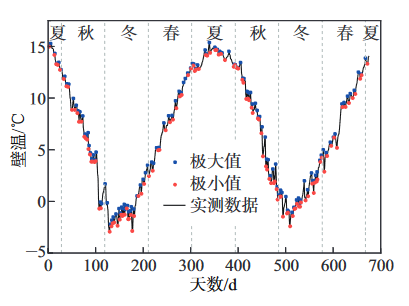
The weathering process of grottoes is directly influenced by environmental parameters. Consequently, estimating these parameters is important for the effective preservation of Yungang Grottoes. This research utilized measured time-series data of wall
temperature, environmental humidity, and temperature from the 10th grotto of Yungang
Grottoes. These data were decomposed into various components using empirical mode decomposition (EMD). Correlations between the measured time-series data and intrinsic
mode function (IMF) components were also investigated. A combined model, based on the
EMD-long short-term memory (LSTM) artificial neural network (ANN), was then developed. Using mean absolute error (MAE), root mean square error (RMSE), mean absolute
percentage error (MAPE), and R2 as the evaluation indices, comparisons were made be-
tween the recorded environmental parameters and those estimated by the combined model
and standalone LSTM-based ANN. The findings suggested that as the rate of change in
the IMF components increased, the correlation between the IMF components and measured time-series increased. When only employing the LSTM-based ANN, optimal results
were obtained with 2 hidden layers and an initial learning rate of 0.001. Conversely, when
using the combined model, MAE, RMSE, and MAPE values decreased, while R2 values in-
creased, indicating the improved estimation efficiency. The accuracy of the environmental
parameter estimations largely depended on the extent of parameter changes, with smaller
changes leading to better model efficiency. The insights gained from this research can be
useful for the preservation of cultural relics of grottoes.
LU Baoming, XU Jinming
. Estimation of environmental parameters of Yungang
Grottoes based on empirical mode decomposition and
long short-term memory artificial neural network[J]. Journal of Shanghai University, 2024
, 30(1)
: 1
-016
.
DOI: 10.12066/j.issn.1007-2861.2409

