Lithium–sulfur (Li–S) batteries have been considered as one of the most promising
systems for next-generation high-energy rechargeable Li batteries owing to their high
theoretical energy density, safe operation, cost effectiveness, and environmental friendliness.
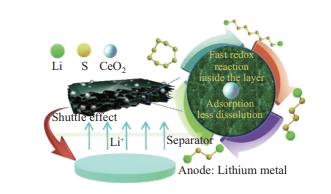
However, the shuttle effect of polysulfide in the charge-discharge process of Li–S battery
degrades its performance in a long-term cycle. MXene-based materials possess excellent
electrical conductivity and high specific surface area, which can effectively avoid the shuttle
effect of polysulfide owing to their enhanced chemical adsorption capacity and catalytic
conversion ability, thereby improving the cycle stability and magnification performance of
Li–S batteries. This paper briefly describes the advantages of using MXene-based materials
in Li–S batteries, summarises the application status of MXene-based composites in
the positive electrodes and separators of Li–S batteries, and the influence of MXene-based materials on the shuttle effect of Li–S batteries. Finally, the future research direction of
MXene-based materials in the field of Li–S batteries is prospected.
LIU Guangsen , CAO Jun , NIU Zhiqiang
. Research progress in the application of MXene-based
materials in lithium-sulfur batteries [J]. Journal of Shanghai University, 2023
, 29(5)
: 842
-858
.
DOI: 10.12066/j.issn.1007-2861.2534

