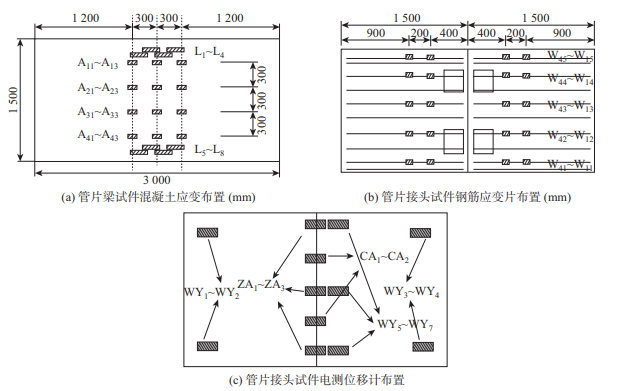
Taking the deeply-buried water storage and sewage shield tunnel project implemented
in Suzhou River of Shanghai as the background, the full-scale static load tests
of segment beams and joints poured with three groups of different fiber reinforced and one
group of non-fiber reinforced concrete were carried out. The tests were conducted using
the multi-functional return frame test system to explore the effects of three kinds of fiber
reinforced concrete on the mechanical properties of segments of deeply-buried water storage
and sewage shield tunnel. The results of segment beam test demonstrated that synthetic
fiber improved the tensile capacity of concrete. When the internal water pressure reached
0.5 MPa, different fibers could reduce the stress of reinforcement by 8%∼22%; moreover,
synthetic fiber could effectively delay the occurrence and inhibit the development of cracks.
The crack width of Barchip fiber segment was reduced by 40%, that of T&W fibers was
reduced by 20%, and that of steel fiber was reduced by 28%. The results of segment joint test indicated that synthetic fiber could improve the overall rigidity of joint specimens;
accordingly, the strength of Barchip fiber was increased by 24%, that of T&W fiber was increased
by 10%, and that of steel fiber was increased by 17%. The synthetic fiber-reinforced
concrete could effectively reduce the degree of broken corner failure in the joint compression
zone when the bolt underwent yielding. In general, Barchip fiber performed better than
steel fiber in inhibiting crack development and improving the overall rigidity of segments
and joints, while the T&W fiber performed slightly worse than steel fiber.