
Journal of Shanghai University >
Improved single neuron gradient learning-based active queue management for wireless networks
Received date: 2018-09-26
Online published: 2021-06-27
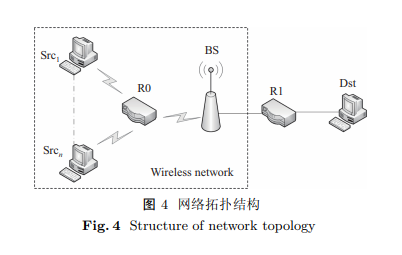
This study introduces a scheme that takes the packet arrival link rate as the input of the controller, where the traditional network congestion control ignores the continuous state of network congestion. Then, an active queue management algorithm that improves single neuron gradient learning (ISNGL) is obtained. The algorithm uses gradient learning to adjust dynamically the network parameters and to improve the convergence rate and stability. The study also proposes a new activation function with displacement parameters and an improved method using momentum adjustment for weights. Finally, NS2 network simulation software is used to simulate a wireless network topology model. Results show that the ISNGL algorithm provides good congestion control capability in wireless networks.
QI Aichun, XU Lei . Improved single neuron gradient learning-based active queue management for wireless networks[J]. Journal of Shanghai University, 2021 , 27(3) : 553 -562 . DOI: 10.12066/j.issn.1007-2861.2172
| [1] | Feng C W, Huang L F, Xu C, et al. Congestion control scheme performance analysis based on nonlinear RED[J]. IEEE Systems Journal, 2017,11(4):2247-2254. |
| [2] | Ko N S, Kim M H, Park H S. FD-AQM: fairness-aware delay-controlled active queue management in 802.11s-based multi-radio multi-channel wireless mesh networks[J]. IEEE Communications Letters, 2015,19(5):839-842. |
| [3] | Miquel T, Condomines J P, Chemali R, et al. Design of a robust controller/observer for TCP/AQM network: first application to intrusion detection systems for drone fleet[C]// Proceedings of the 2017 IEEE/RSJ International Conference on Intelligent Robots and Systems. 2017: 1707-1712. |
| [4] | Boudi A, Loudini M. Active queue management exploiting the rate information in TCP-IP networks[J]. IEEE/CAA Journal of Automatica Sinica, 2018,5(1):223-231. |
| [5] | Akashdeep, Kahlon K S, Kaushal M. Analysis of a queue length aware and latency guaranteed fuzzy-based adaptive resource allocator for WiMAX networks[J]. Optik, 2016,127(1):357-367. |
| [6] | Liu Z, Sun J, Hu S, et al. An adaptive AQM algorithm based on a novel information compression model[J]. IEEE Access, 2018,6:31180-31190. |
| [7] | Xiao K, Mao S, Tugnait J K. MAQ: a multiple model predictive congestion control scheme for cognitive radio networks[J]. IEEE Transactions on Wireless Communications, 2017,16(4):2614-2626. |
| [8] | Mohammadi M R, Sadrossadat S A, Mortazavi M G, et al. A brief review over neural network modeling techniques[C]// Proceedings of the IEEE International Conference on Power, Control, Signals and Instrumentation Engineering. 2017: 54-57. |
| [9] | Cordero J A. Multi-path TCP performance evaluation in dual-homed (wired/wireless) devices[J]. Journal of Network and Computer Applications, 2016,70:131-139. |
| [10] | Li F, Sun J, Zukerman M, et al. A comparative simulation study of TCP/AQM systems for evaluating the potential of neuron-based AQM schemes[J]. Journal of Network and Computer Applications, 2014,41:274-299. |
| [11] | Zheng F, Nelson J. An $H_{\infty }$ approach to congestion control design for AQM routers supporting TCP flows in wireless access networks[J]. Computer Networks, 2007,51(6):1684-1704. |
/
| 〈 |
|
〉 |
