
Journal of Shanghai University >
Event extraction of Chinese text based on composite neural network
Received date: 2020-02-23
Online published: 2021-06-27
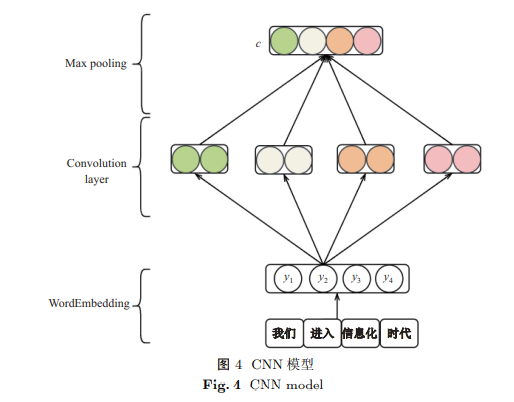
The recurrent neural network is widely used in the event extraction of Chinese text to extract events and event elements, but it usually loses essential information when processing long words. In this study, the convolutional neural network (CNN) and the bidirectional long short-term memory (Bi-LSTM) network were combined to develop a novel event extraction model known as CNN-Bi-LSTM-conditional random field (CRF). A joint vector of characters and words was adopted based on the attention mechanism and semantic features, and the CNN and Bi-LSTM models were used to process the vector to obtain its implicit representation. Finally, the CRF was used to obtain the prediction results. The experimental results show that the proposed method is more accurate than other existing event extraction methods in extracting Chinese text.
Zhongxiang JI , Yue WU . Event extraction of Chinese text based on composite neural network[J]. Journal of Shanghai University, 2021 , 27(3) : 535 -543 . DOI: 10.12066/j.issn.1007-2861.2223
| [1] | Doddington G, Mitchell A, Przybocki M, et al. The automatic content extraction (ACE) program-tasks, data, and evaluation[C]// Proceedings of the Fourth International Conference on Language Resources and Evaluation. 2004: 837-840. |
| [2] | Consortium L D. ACE (automatic content extraction) Chinese annotation guidelines for events [EB/OL]. [2020-02-20]. http://www.ldc.upenn.edu/Projects/ACE. |
| [3] | 罗明, 黄海量. 一种基于有限状态机的中文地址标准化方法[J]. 计算机应用研究, 2016,33(12):3691-3695. |
| [3] | Luo M, Huang H L. New method of Chinese address standardization based on finite state machine theory[J]. Application Research of Computers, 2016,33(12):3691-3695. |
| [4] | Mohammed G H A Z, Can A B. ROLEX-SP: rules of lexical syntactic patterns for free text categorization[J]. Knowledge-Based Systems, 2011,24(1):58-65. |
| [5] | 刘丹丹, 彭成, 钱龙华, 等. 词汇语义信息对中文实体关系抽取影响的比较[J]. 计算机应用, 2012,32(8):2238-2244. |
| [5] | Liu D D, Peng C, Qian L H, et al. Comparative analysis of impact of lexical semantic information on Chinese entity relation extraction[J]. Journal of Computer Applications, 2012,32(8):2238-2244. |
| [6] | Chieu H L, Ng H T. A maximum entropy approach to information extraction from semi-structured and free text[C]// Proceedings of the Eighteenth National Conference on Artificial Intelligence. 2002: 786-791. |
| [7] | Ahn D. The stages of event extraction[C]// Proceedings of the Workshop on Annotations and Reasoning about Time and Events. 2006: 1-8. |
| [8] | 付剑锋, 刘宗田, 刘炜, 等. 基于特征加权的事件要素识别[J]. 计算机科学, 2010,37(3):239-241. |
| [8] | Fu J F, Liu Z T, Liu W, et al. Feature weighting based event argument identification[J]. Computer Science, 2010,37(3):239-241. |
| [9] | Zeng Y, Yang H H, Feng Y S, et al. A convolution Bi-LSTM neural network model for Chinese event extraction[C]// Proceedings of International Conference on Computer Processing of Oriental Languages. 2016: 275-287. |
| [10] | 张亚军, 刘宗田, 周文. 基于深度信念网络的事件识别[J]. 电子学报, 2017,45(6):1415-1423. |
| [10] | Zhang Y J, Liu Z T, Zhou W. Event recognition based on deep belief network[J]. Acta Electronica Sinica, 2017,45(6):1415-1423. |
| [11] | Wu Y, Zhang J. Chinese event extraction based on attention and semantic features: a bidirectional circular neural network[J]. Future Internet, 2018,10(10):95-105. |
| [12] | Chen X, Xu L, Liu Z, et al. Joint learning of character and word embeddings[C]// Proceedings of the 24th International Conference on Artificial Intelligence. 2015: 1236-1242. |
| [13] | Misawa S, Taniguchi M, Miura Y, et al. Character-based bidirectional LSTM-CRF with words and characters for Japanese named entity recognition[C]// Proceedings of the First Workshop on Subword and Character Level Models in NLP. 2017: 97-102. |
| [14] | Sato M, Shindo H, Yamada I, et al. Segment-level neural conditional random fields for named entity recognition[C]// Proceedings of the Eighth International Joint Conference on Natural Language Processing. 2017: 97-102. |
/
| 〈 |
|
〉 |
