Vacancy trapping during HCP-Mg solidification under different degrees of undercooling

  • FU Jiahao ,
  • ZHANG Boyang ,
  • ZHANG Kai ,
  • ZHOU Tao ,
  • WANG Hao ,
  • WU Yongquan
Expand
  • State Key Laboratory of Advanced Special Steel, School of Materials Science and Engineering, Shanghai University, Shanghai 200444, China

Accepted date: 2021-06-11

  Online published: 2021-06-18
Abstract

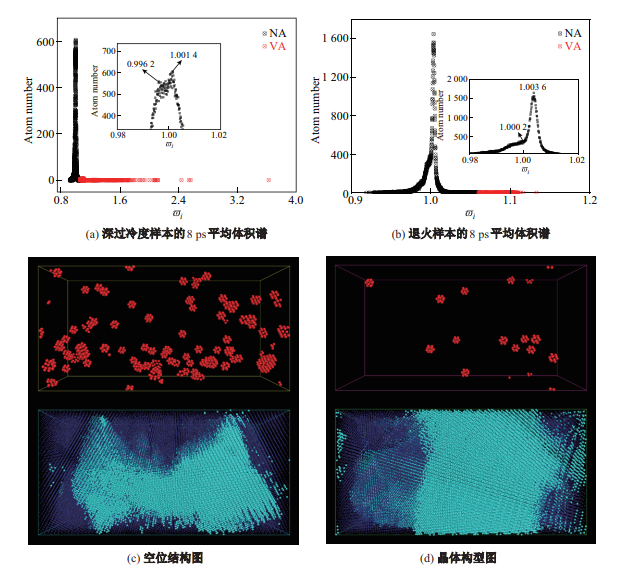
Different molecular dynamics (MD) techniques were used to simulate the solid-ification and annealing processes of hexagonal close-packed (HCP) metal Mg under deep, medium, and shallow undercooling conditions. A newly constructed time-averaged atomic volume spectrum (TAVS) method was then utilized to locate and analyse the trapped va-cancies. The results showed that the vacancy trapping effect worked dramatically during solidification, meaning that the greater the degree of undercooling, the higher was the con-centration of trapped vacancies. In addition, the trapping concentration was much higher than the corresponding equilibrium concentration. Moreover, it was found that HCP-Mg had a certain number of self-interstitial atoms during the solidification process, which con-trasted fully with the more symmetrical face-centred cubic (FCC) metal Al. Finally, the atomic cage of vacancy in HCP-Mg featured a remarkable outward displacement instead of the generally accepted inward displacement of vacancy atoms (VA) in metals.

Cite this article

FU Jiahao , ZHANG Boyang , ZHANG Kai , ZHOU Tao , WANG Hao , WU Yongquan . Vacancy trapping during HCP-Mg solidification under different degrees of undercooling[J]. Journal of Shanghai University, 2023 , 29(2) : 323 . DOI: 10.12066/j.issn.1007-2861.2318

Outlines

/