
Journal of Shanghai University >
Cooperative efficiency measurement of China's provincial science financial system based on network data envelopment analysis and its time-spatial differences
Received date: 2018-05-23
Online published: 2020-12-29
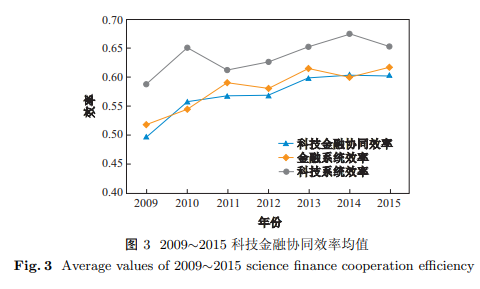
Based on the provincial panel data from 2009 to 2015, using network data envelopment analysis (DEA), this study measures the input-output efficiency of the financial and technology systems and their cooperative efficiency. The Moran index is used to test the spatial correlation of cooperative efficiency. The results revealed that there is a large promotion space for the cooperative efficiency of China's technology and financial systems. There are significant differences among regions, and only Beijing, Shanghai, and Jiangsu reach DEA efficiency. In terms of the time dimension, the cooperative efficiency shows an upward trend year by year and increases by 15% in seven years. In terms of the space dimension, the efficiency of each system shows good spatial correlation, and the correlation increases year by year. The cooperative efficiency of neighboring provinces of Guangdong and Chongqing needs to be improved. Based on the research results, this study puts forward some suggestions for improving the coordination of China's science financial and technology systems.
Mingkang SHI , Liying YU . Cooperative efficiency measurement of China's provincial science financial system based on network data envelopment analysis and its time-spatial differences[J]. Journal of Shanghai University, 2020 , 26(6) : 1015 -1025 . DOI: 10.12066/j.issn.1007-2861.2101
| [1] | Popov A, Roosenboom P. Venture capital and patented innovation: evidence from Europe[J]. Economic Policy, 2012,27(71):447-482. |
| [2] | Chowdhury R H, Min M. Financial market development and the effectiveness of R&D investment: evidence from developed and emerging countries[J]. Research in International Business and Finance, 2012,26(2):258-272. |
| [3] | 张倩, 张玉喜. 科技型企业金融生态环境、财务柔性与研发投入——对我国30个省区840家科技型企业的实证分析[J]. 研究与发展管理, 2017,29(5):66-76. |
| [4] | 王洪生. 金融环境、融资能力与中小型科技企业成长[J]. 当代经济研究, 2014(3):86-91. |
| [5] | 翟华云, 方芳. 区域科技金融发展、R&D投入与企业成长性研究——基于战略性新兴产业上市公司的经验证据[J]. 科技进步与对策, 2014,31(5):34-38. |
| [6] | 钱水土, 张宇. 科技金融发展对企业研发投入的影响研究[J]. 科学学研究, 2017,35(9):1320-1325. |
| [7] | 陈翔, 肖序. 中国工业产业循环经济效率区域差异动态演化研究与影响因素分析——来自造纸及纸制品业的实证研究[J]. 中国软科学, 2015(1):160-171. |
| [8] | 董艳梅, 朱英明. 中国高技术产业创新效率评价——基于两阶段动态网络DEA模型[J]. 科技进步与对策, 2015,32(24):106-113. |
| [9] | 龚光明, 单虹. 基于动态网络DEA的中国高技术企业创新效率研究[J]. 科学管理研究, 2015,33(1):60-63. |
| [10] | 韩松, 苏熊. 中国商业银行结构效率研究: 基于复杂网络DEA模型[J]. 中国管理科学, 2016,24(8):1-9. |
| [11] | Lftikhar Y, He W, Wang Z. Energy and CO$_2$, emissions efficiency of major economies: a non-parametric analysis[J]. Journal of Cleaner Production, 2016,139:779-787. |
| [12] | Liu Y, Wang K. Energy efficiency of China's industry sector: an adjusted network DEA (data envelopment analysis)-based decomposition analysis[J]. Energy, 2015,93:1328-1337. |
| [13] | Fare R, Grosskop S. Network DEA[J]. Socio-Economic Planning Sciences, 2000,34(1):35-49. |
| [14] | 林光平, 龙志和, 吴梅. 我国地区经济收敛的空间计量实证分析:1978—2002年[J]. 经济学(季刊), 2005(S1):67-82. |
| [15] | 张小峰, 房汉廷. 科技成果熟化的共生目标模式研究[J]. 科技进步与对策, 2013,30(11):15-19. |
| [16] | 吴延兵. 中国地区工业知识生产效率测算[J]. 财经研究, 2008(10):4-14. |
| [17] | 曹颢, 尤建新, 卢锐, 等. 我国科技金融发展指数实证研究[J]. 中国管理科学, 2011,19(3):134-140. |
| [18] | 孙志红, 吴悦. 财政投入、银行信贷与科技创新效率——基于空间GWR模型的实证分析[J]. 华东经济管理, 2017,31(4):74-81. |
| [19] | 张玉喜, 赵丽丽. 中国科技金融投入对科技创新的作用效果——基于静态和动态面板数据模型的实证研究[J]. 科学学研究, 2015,33(2):177-184. |
| [20] | 徐玉莲, 王玉冬. 区域科技创新与科技金融系统协同发展运行机理分析[J]. 科技进步与对策, 2013,30(20):25-29. |
/
| 〈 |
|
〉 |
