
Journal of Shanghai University >
Incentive problem of collaborative technology innovation in mega projects considering fairness preference
Received date: 2019-03-27
Online published: 2020-11-06
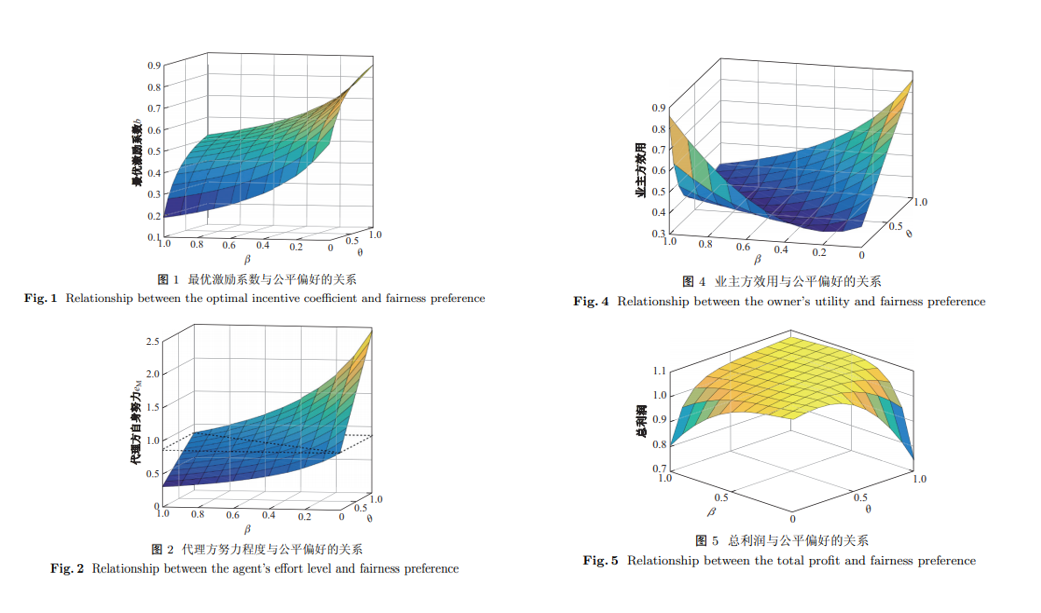
This study focuses on the incentive mechanism of collaborative technology innovation of mega projects. To analyse the impact of fairness preference on the design of incentive mechanism, this study discusses four situations based on the principal-agent theory: both sides have fairness preference, both sides are self-interested, the agent has fairness preference, and the owner has fairness preference. The results reveal that when the fairness preference of the two sides is not equal, the optimal incentive coefficient is positively correlated with the agent's fairness preference, while negatively correlated with that of the owner. When the fairness preference of the two sides is equal, the fixed payment changes negatively with the fairness preference, and the output contribution rate changes the influence of fairness preference on the incentive coefficient. The final performance is that the output sharing proportion obtained by the side with the lower contribution rate is positively correlated to fairness preference, but not more than 0.5. The numerical modelling shows that the gap between two sides' fairness preference is beneficial to the improvement of the owner's utility, but a wide gap is unfavorable to the total profit.
MA Guanghong, LIU Jiawei . Incentive problem of collaborative technology innovation in mega projects considering fairness preference[J]. Journal of Shanghai University, 2020 , 26(5) : 756 -768 . DOI: 10.12066/j.issn.1007-2861.2122
| [1] | Freeman C. Network of innovators: a synjournal of research issues[J]. Research Policy, 1991,20(5):499-514. |
| [2] | Pekkarinen S, Harmaakorpi V. Building regional innovation networks: the definition of an age business core process in a regional innovation system[J]. Regional Studies, 2006,40(4):401-413. |
| [3] | Keast R L, Hampson K D. Building constructive innovation networks: role of relationship management[J]. Journal of Construction Engineering and Management-asce, 2007,133(5):364-373. |
| [4] | Manley K. The innovation competence of repeat public sector clients in the Australian construction industry[J]. Construction Management and Economics, 2006,24(12):1295-1304. |
| [5] | 李迁, 游庆仲, 盛昭瀚. 大型建设工程的技术创新系统研究[J]. 科学学与科学技术管理, 2006(12):93-96. |
| [6] | 麦强, 安实, 林翰, 等. 重大工程复杂性与适应性组织——港珠澳大桥的案例[J]. 管理科学, 2018,31(3):86-99. |
| [7] | 李盛竹, 付小红. 促进知识互补效应的我国产学研合作科研创新激励机制研究[J]. 科学管理研究, 2014,32(3):52-55. |
| [8] | 黄波, 陈晖, 黄伟. 引导基金模式下协同创新利益分配机制研究[J]. 中国管理科学, 2015,23(3):66-75. |
| [9] | 曾祥炎, 刘友金, 凌志鹏. 剩余分配契约与集群企业产学研协同创新效率[J]. 系统工程, 2016,34(6):78-83. |
| [10] | Fehr E, Schmidt K M. A theory of fairness, competition and cooperation[J]. Quarterly Journal of Economics, 1999,114(3):817-868. |
| [11] | 蒲勇健, 郭心毅, 陈斌. 基于公平偏好理论的激励机制研究[J]. 预测, 2010,29(3):6-11. |
| [12] | Du S, Nie T, Chu C, et al. Newsvendor model for a dyadic supply chain with Nash bargaining fairness concerns[J]. International Journal of Production Research, 2014,52(17):5070-5085. |
| [13] | Zhou Y, Bao M, Chen X, et al. Co-op advertising and emission reduction cost sharing contracts and coordination in low-carbon supply chain based on fairness concerns[J]. Journal of Cleaner Production, 2016,133:402-413. |
| [14] | 亚灵, 李会玲, 柯洪. 工程项目中业主初始信任对合作的影响研究: 承包商公平感知的中介作用[J]. 管理学报, 2014,11(10):1542-1551. |
| [15] | 朱建波, 时茜茜, 盛昭瀚, 等. DB 模式下考虑公平偏好的重大工程设计施工合作机制[J]. 系统管理学报, 2018,27(5):872-880. |
| [16] | 陈哲, 陈国宏. 考虑公平参照点差异的建设项目绿色合作努力行为决策[J]. 控制与决策, 2018,33(6):1107-1116. |
| [17] | Siemsen E, Balasubramanian S, Roth A V, et al. Incentives that induce task-related effort, helping, and knowledge sharing in workgroups[J]. Management Science, 2007,53(10):1533-1550. |
| [18] | 陈哲, 陈国宏. 建设项目绿色创新努力及利他偏好诱导[J]. 中国管理科学, 2018,26(7):187-196. |
/
| 〈 |
|
〉 |
