
Journal of Shanghai University >
Molecular simulation of dislocation nucleation induced by nanosized helium bubbles in irradiated tungsten materials
Received date: 2020-04-13
Online published: 2020-06-12
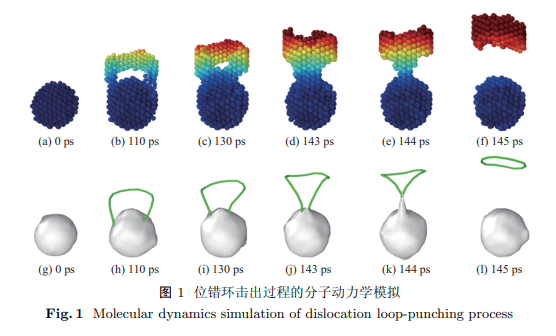
Based on molecular dynamics simulation, the effects of helium bubble pressure, bubble size, and bubble temperature on the mechanism of dislocation nucleation in irradiated tungsten materials are investigated. The nudged elastic band (NEB) method is applied to analyze the energy barrier of dislocation nucleation induced by a helium bubble for the first time. An ultimate value of the helium/vacancy ratio is determined. When the helium/vacancy ratio exceeds this ultimate value, a nanosized helium bubble is generated and a prismatic dislocation loop is formed and grows, through dislocation nucleation driven by high internal pressure, dislocation competition and reaction, and dislocation cross-slip. The ultimate internal pressure required for dislocation nucleation induced by the helium bubbles decreases with the increase in temperature and the growth of the helium bubbles. Increasing the helium/vacancy ratio can effectively reduce the energy barrier required for dislocation nucleation.
HUANG Xinlong, Lü Chenyangtao, SUN Yuyao, CHU Haijian . Molecular simulation of dislocation nucleation induced by nanosized helium bubbles in irradiated tungsten materials[J]. Journal of Shanghai University, 2021 , 27(6) : 1065 -1073 . DOI: 10.12066/j.issn.1007-2861.2222
| [1] | Zinkle S J, Was G S. Materials challenges in nuclear energy[J]. Acta Materialia, 2013, 61(3): 735-758. |
| [2] | Hammond K D, Blondel S, Hu L, et al. Large-scale atomistic simulations of low-energy helium implantation into tungsten single crystals[J]. Acta Materialia, 2018, 144:561-578. |
| [3] | Rasch K D, Siegel R W, Schultz H, et al. Quenching and recovery investigations of vacancies in tungsten[J]. Philosophical Magazine, 1980, 41(1): 91-117. |
| [4] | Kajita S, Yoshida N, Yoshihara R, et al. TEM observation of the growth process of helium nanobubbles on tungsten: nanostructure formation mechanism[J]. Journal of Nuclear Materials, 2011, 418(1): 152-158. |
| [5] | Debelle A, Barthe M F, Sauvage T, et al. Helium behaviour and vacancy defect distribution in helium implanted tungsten[J]. Journal of Nuclear Materials, 2007, 362(2): 181-188. |
| [6] | Wilson W D, Bisson C L, Baskes M I, et al. Self-trapping of helium in metals[J]. Physical Review B, 1981, 24(10): 5616-5624. |
| [7] | Sefta F, Hammond K D, Juslin N, et al. Tungsten surface evolution by helium bubble nucleation, growth and rupture[J]. Nuclear Fusion, 2013, 53(7): 073015. |
| [8] | Sikka V K, Moteff J. Superlattice of voids in neutron-irradiated tungsten[J]. Journal of Applied Physics, 1972, 43(12): 4942-4944. |
| [9] | Frechard S, Walls M, Kociak M, et al. Study by EELS of helium bubbles in a martensitic steel[J]. Journal of Nuclear Materials, 2009, 393(1): 102-107. |
| [10] | Wolfer W G. The pressure for dislocation loop punching by a single bubble[J]. Philosophical Magazine, 1988, 58(2): 285-297. |
| [11] | Trinkaus H, Wolfer W G. Conditions for dislocation loop punching by helium bubbles[J]. Journal of Nuclear Materials, 1984, 122:552-557. |
| [12] | Xie H, Gao N, Xu K, et al. A new loop-punching mechanism for helium bubble growth in tungsten[J]. Acta Materialia, 2017, 141:10-17. |
| [13] | Peng Q, Meng F, Yang Y, et al. Shockwave generates dislocation loops in bcc iron[J]. Nature Communications, 2018, 9(1): 4880. |
| [14] | Juslin N, Wirth B D. Interatomic potentials for simulation of He bubble formation in W[J]. Journal of Nuclear Materials, 2013, 432(1): 61-66. |
| [15] | Finnis M W, Sinclair J E. A simple empirical N-body potential for transition metals[J]. Philosophical Magazine, 1984, 50(1): 45-55. |
| [16] | Ackland G, Thetford R. An improved N-body semi-empirical model for body-centred cubic transition metals[J]. Philosophical Magazine, 1987, 56(1): 15-30. |
| [17] | Beck D E. A new interatomic potential function for helium[J]. Molecular Physics, 1968, 14(4): 311-315. |
| [18] | Stukowski A. Visualization and analysis of atomistic simulation data with OVITO-the open visualization tool[J]. Modelling and Simulation in Materials Science and Engineering, 2010, 18(1): 015012. |
| [19] | Stukowski A. Structure identification methods for atomistic simulations of crystalline mate-rials[J]. Modelling and Simulation in Materials Science and Engineering, 2012, 20(4): 045021. |
| [20] | Stukowski A, Bulatov V V, Arsenlis A, et al. Automated identification and indexing of dislocations in crystal interfaces[J]. Modelling and Simulation in Materials Science and Engineering, 2012, 20(8): 085007. |
| [21] | Steinberg D J, Cochran S G, Guinan M W, et al. A constitutive model for metals applicable at high-strain rate[J]. Journal of Applied Physics, 1980, 51(3): 1498-1504. |
| [22] | Peng J, Jing F, Li D, et al. Pressure and temperature dependence of shear modulus and yield strength for aluminum, copper and tungsten under shock compression[J]. Journal of Applied Physics, 2005, 98(1): 013508. |
/
| 〈 |
|
〉 |
