
Journal of Shanghai University >
Stitching algorithm of multi-mode fusional vehicle panorama
Received date: 2018-07-13
Online published: 2018-12-23
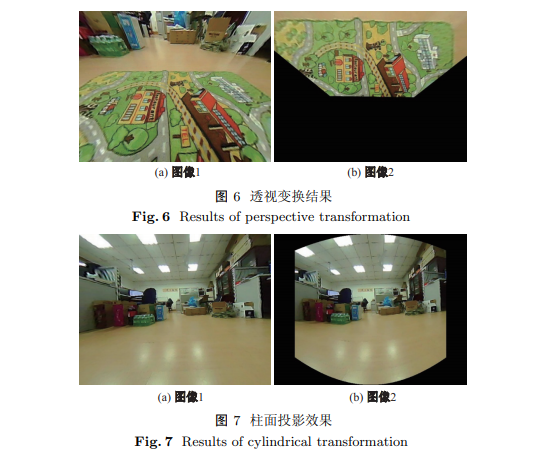
As the traditional driver assistant system provides only one viewpoint, its usage is limited. A panoramic stitching algorithm, which can automatically switch between forward and backward modes, is proposed. This algorithm can provide a more flexible viewpoint for drivers. First, the distortion of images input by fish-eye cameras is corrected. Second, the driving direction is deduced by the displacements of the feature points detected between adjacent images. Third, the viewpoint transformation is chosen according to the driving direction, using cylindrical projection for the forward direction and perspective transformation for the backward direction. Finally, images are matched using piecewise stitching in place of the traditional stitching method and overlapped regions are fused. The model can automatically switch the mode according to the driving direction. The images of the cameras are highly reserved. The time cost for the cylindrical projection of this model is 75% lower than the traditional value.
LIU Chang, XU Meihua, GUO Aiying . Stitching algorithm of multi-mode fusional vehicle panorama[J]. Journal of Shanghai University, 2020 , 26(6) : 909 -920 . DOI: 10.12066/j.issn.1007-2861.2098
| [1] | 蔡丽欢, 廖英豪, 郭东辉. 图像拼接方法及其关键技术研究[J]. 计算机技术与发展, 2008,18(3):1-4. |
| [2] | Brown M, Lowe D G. Automatic panoramic image stitching using invariant features[J]. International Journal of Computer Vision, 2007,74(1):59-73. |
| [3] | Lowe D G. Object recognition from local scale-invariant features[C]// The Proceedings of the Seventh IEEE International Conference on Computer Vision. 2002: 1150. |
| [4] | Lowe D G. Local feature view clustering for 3D object recognition[C]// 2001 IEEE Conference on Computer Vision and Pattern Recognition (CVPR). 2001: 682-688. |
| [5] | Bay H, Ess A, Tuytelaars T, et al. Speeded-up robust features[J]. Computer Vision and Image Understanding, 2008,110(3):404-417. |
| [6] | Joo K, Kim N, Oh T H, et al. Line meets as-projective-as-possible image stitching with moving DLT[C]// IEEE International Conference on Image Processing. 2015. DOI: 10.1109/ICIP.2015.7350985. |
| [7] | 李晓辉, 周荫清, 王祖林. 基于曲面拼接的球面全景生成算法[J]. 北京航空航天大学学报, 2007,33(6):668-671. |
| [8] | 刘冬, 秦瑞, 陈曦, 等. 3D车载环视全景生成方法[J]. 计算机科学, 2017,44(4):302-305. |
| [9] | 杨刚, 臧春华, 李仲年. 基于参考点配准法的全景泊车系统研究[J]. 传感器与微系统, 2017,36(10):41-44. |
| [10] | 李彬. 全景视频实时拼接技术研究[D]. 西安: 西安工业大学, 2016. |
| [11] | 杨镇豪. 基于柱面变换的图像拼接技术[J]. 现代计算机(专业版), 2018(10):11-14. |
| [12] | 张建伟, 雷霖. 基于透视投影的垂直视角投影算法研究[J]. 成都大学学报(自然科学版), 2017,36(1):47-50. |
| [13] | Fischler M A. Random sample consensus: a paradigm for model fitting with applications to image analysis and automated cartography[J]. Readings in Computer Vision, 1987,24(6):726-740. |
| [14] | Zhang Z. Parameter estimation techniques: a tutorial with application to conic fitting[J]. Image Vision Comput, 1997,15(1):59-76. |
| [15] | Mokhtarian F, Suomela R. Robust image corner detection through curvature scale space[J]. IEEE Transactions on Pattern Analysis and Machine Intelligence, 1999,20(12):1376-1381. |
| [16] | Zhang Z Y. A flexible new technique for camera calibration[J]. IEEE Transactions on Pattern Analysis and Machine Intelligence, 2000,22(11):1330-1334. |
| [17] | Budil D E, Lee S, Saxena S, et al. Nonlinear-least-squares analysis of slow-motion EPR spectra in one and two dimensions using a modified levenberg—marquardt algorithm[J]. Journal of Magnetic Resonance, 1996,120(2):155-189. |
| [18] | Chang C H, Sato Y, Chuang Y Y. Shape-preserving half-projective warps for imagestitching[C]// 2014 IEEE Conference on Computer Vision and Pattern Recognition (CVPR). 2014: 3254-3261. |
| [19] | 厉丹, 肖理庆, 田隽, 等. 基于改进相位相关与特征点配准的多图拼接算法[J]. 计算机科学, 2018,45(1):313-319. |
/
| 〈 |
|
〉 |
