
Journal of Shanghai University >
Application of CFD-DEM coupling method in seepage-induced ground subsidence
Received date: 2018-08-03
Online published: 2018-12-23
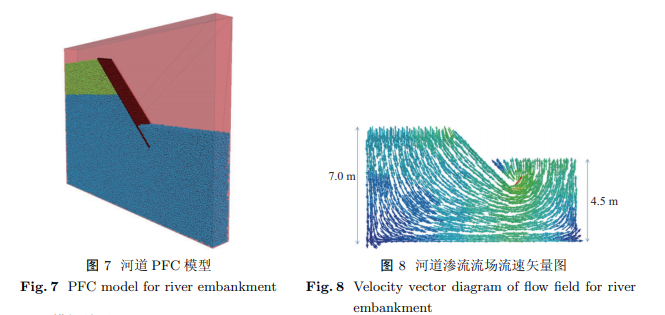
One of the main causes of urban ground subsidence is groundwater seepage. Finite element method is not an ideal method to reveal the microscopic mechanism of ground settlement. With discrete element method, the microscopic mechanism may be revealed, but it doesn't help with the building of a flow filed model with complex shape. Based on discrete element method (DEM) and computational fluid dynamics (CFD) coupling principle, a fluid-solid coupling method is proposed. This method uses PFC to simulate the solid phase and Fluent to simulate the liquid phase. It achieves fluid-solid coupling calculation based on particle microscopic view. Then this method is applied to the study of ground settlement caused by seepage. The effectiveness and feasibility of this method are verified by three examples. It is found that the PFC-Fluent method can show the whole dynamic process of ground settlement caused by seepage from a microscopic perspective, and can also realize the simulation and calculation of various complex shape conditions. The stability of soil was changed under the influence of seepage, and the soil migration lead to ground subsidence. Land subsidence increases with the rise of hydraulic gradient. This study reveals the whole process of ground subsidence under the action of hydraulic gradient, which provides a basis for the prevention and control of urban geological hazards.
LI Xiaojiao, LU Ye, WU Yajun . Application of CFD-DEM coupling method in seepage-induced ground subsidence[J]. Journal of Shanghai University, 2020 , 26(5) : 842 -852 . DOI: 10.12066/j.issn.1007-2861.2093
| [1] | Zhang D M, Ma L X, Zhang J, et al. Ground and tunnel responses induced by partial leakage in saturated clay with anisotropic permeability[J]. Engineering Geology, 2015,189:104-115. |
| [2] | Mair R J. Tunnelling and geotechnics: new horizons[J]. Geotechnique, 2008,58(9):695-736. |
| [3] | Ravichandran N, Machmer B, Krishnapillai H, et al. Micro-scale modeling of saturated sandy soil behavior subjected to cyclic loading[J]. Soil Dynamics and Earthquake Engineering, 2010,30(11):1212-1225. |
| [4] | Cundall P A, Strack O D L. A discrete numerical model for granular assemblies[J]. Geotechnique, 1979,29(1):47-65. |
| [5] | 周健, 池永. 土的工程力学性质的颗粒流模拟[J]. 固体力学学报, 2004,25(4):377-382. |
| [6] | 蒋明镜, 胡海军, 彭建兵. 结构性黄土一维湿陷特性的离散元数值模拟[J]. 岩土力学, 2013,34(4):1121-1130. |
| [7] | 王宇, 李晓, 王声星, 等. 滑坡渐进破坏运动过程的颗粒流仿真模拟[J]. 长江科学院院报, 2012,29(12):46-52. |
| [8] | Li L, Holt R M. Simulation of flow in sandstone with fluid coupled particle model[C]// 38th U.S. Symposium on Rock Mechanics. 2001. |
| [9] | 倪小东, 赵帅龙, 王媛, 等. 岩体水力劈裂的细观 PFC-CFD 联合分析[J]. 岩石力学与工程学报, 2015,34(S2):3862-3870. |
| [10] | Zeghal M, Shamy U E. Coupled continuum–discrete model for saturated granular soils[J]. Journal of Engineering Mechanics, 2005,131(4):413-426. |
| [11] | 周健, 周凯敏, 姚志雄, 等. 砂土管涌-滤层防治的离散元数值模拟[J]. 水利学报, 2010,41(1):17-24. |
| [12] | 罗勇, 龚晓南, 吴瑞潜. 颗粒流模拟和流体与颗粒相互作用分析[J]. 浙江大学学报 (工学版), 2007,41(11):1932-1936. |
| [13] | 蒋明镜, 张望城. 一种考虑流体状态方程的土体 CFD-DEM 耦合数值方法[J]. 岩土工程学报, 2013,36(5):793-801. |
| [14] | 王胤, 艾军, 杨庆. 考虑粒间滚动阻力的 CFD-DEM 流-固耦合数值模拟方法[J]. 岩土力学, 2017,38(6):1771-1780. |
| [15] | Ergun S. Fluid flow through packed column[J]. Chemical Engineering Progress, 1952,48(2):89-94. |
| [16] | 罗勇. 土工问题的颗粒流数值模拟及应用研究[D]. 杭州: 浙江大学, 2007. |
/
| 〈 |
|
〉 |
