
Journal of Shanghai University >
Modelling solids with fluid-filled pores using eigenstrain formulation of boundary integral equations
Received date: 2018-08-14
Online published: 2018-12-23
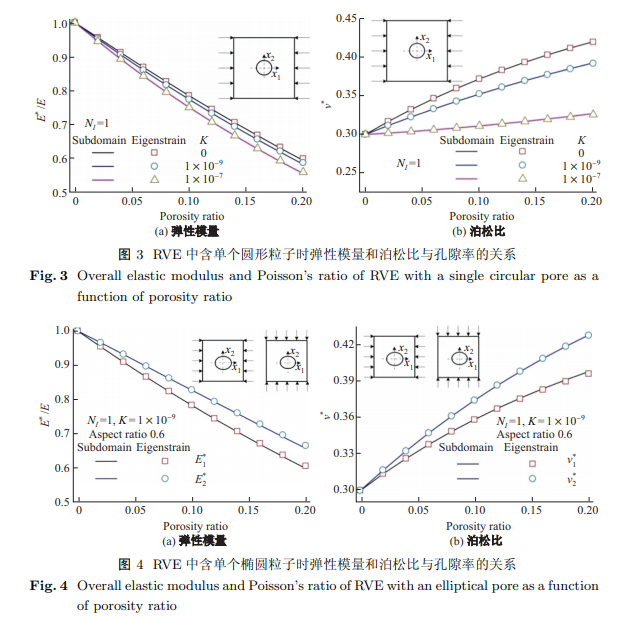
In view of the fact that elastic solids contain fluid-filled pores, Eshelby's idea of eigenstrain and equivalent inclusion has been incorporated into the boundary integral equations (BIE), and as a result, the computational model of eigenstrain boundary integral equations and the corresponding iterative solution procedures are presented in the paper for the numerical simulation of solids with fluid-filled pores in great number. In order to guarantee the convergence of iteration sufficiently, the local Eshelby matrix has been proposed and constructed from the BIE combined with Eshelby's idea. The feasibility and effectiveness of the proposed computational model are verified in comparison with the results of the analytical solution in the case of a single circular fluid-filled pore in full space and of the subdomain BIE in other cases. The overall mechanical properties of solids are computed using a representative volume element (RVE) with more than one thousand fluid-filled pores distributed either regularly or randomly with the proposed computational model, showing the feasibility and high efficiency of the present model and the solution procedures.
Jicheng ZHOU , Donghong HE , Hang MA . Modelling solids with fluid-filled pores using eigenstrain formulation of boundary integral equations[J]. Journal of Shanghai University, 2020 , 26(5) : 790 -801 . DOI: 10.12066/j.issn.1007-2861.2090
| [1] | Zimmerman R. Compressibility of sand-stones[M]. Amsterdam: The Netherland, Elsevier Science Publishers, 1991. |
| [2] | Kachanov M, Tsukrov I, Shafiro B. Materials with fluid-saturated cracks and cavities: fluid pressure polarization and effective elastic response[J]. International Journal of Fracture, 1995,73:R61-R66. |
| [3] | Giraud A, Huynh Q V. Application of results on Eshelby tensor to the determination of the effective pyroclastic properties of anisotropic rock-like composites[J]. International Journal of Solids and Structures, 2007,44:3756-3772. |
| [4] | Eshelby J D. The determination of the elastic field of an ellipsoidal inclusion and related problems[J]. Proceedings of the Royal Society of London, 1957,241:376-396. |
| [5] | Kiris A, Inan E. Eshelby tensors for a spherical inclusion in micro elongated elastic fields[J]. International Journal of Engineering Science, 2005,43:49-58. |
| [6] | Shen L X, Yi S. An effective inclusion model for effective moluli of heterogeneous materials with ellipsoidal inhomogenneities[J]. International Journal of Solids and Structures, 2001,38:5789-5805. |
| [7] | Mura T, Shodja H M, Hirose Y. Inclusion problems (part 2)[J]. Applied Mechanics Reviews, 1996,49:S118-S127. |
| [8] | Federico S, Grillac A, Herzog W. A transversely isotropic composite with a statistical distribution of spheroidal inclusion: a geometrical approach to overall properties[J]. Journal of the Mechanics and Physics of Solids, 2004,52:2309-2327. |
| [9] | Franciosi P, Lormand G. Using the radon transform to solve inclusion problems in elasticity[J]. International Journal of Solids and Structures, 2004,41:585-606. |
| [10] | Ma H, Deng H L. Nondestructive determination of welding residual stresses by boundary element method[J]. Advances in Engineering Software, 1998,29:89-95. |
| [11] | Ma H, Yan C, Qin Q H. Eigenstrain boundary integral equations with local Eshelby matrix for stress analysis of ellipsoidal particles[J]. Mathematical Problems in Engineering, 2014. DOI: 10.1155/2014/947205. |
| [12] | Ma H, Fang J B, Qin Q H. Simulation of ellipsoidal particle-reinforced materials with eigenstrain formulation of 3D BIE[J]. Advances in Engineering Software, 2011,42(10):750-759. |
| [13] | Tang Y J, Ma H, Yan C. Local Eshelby matrix in eigen-variable boundary integral equations for solids with particles and cracks in full space[J]. Engineering Analysis with Boundary Elements, 2016,71(10):59-69. |
| [14] | Huang Q Z, Zheng X P, Yao Z H. Boundary element method for 2D solids with fluid-filled pores[J]. Engineering Analysis with Boundary Elements, 2011,35:191-199. |
| [15] | Ma H, Zhou J, Qin Q H. Boundary point method for linear elasticity using constant and quadratic moving elements[J]. Advances in Engineering Software, 2010,41:480-488. |
/
| 〈 |
|
〉 |
