Journal of Shanghai University(Natural Science Edition) ›› 2021, Vol. 27 ›› Issue (2): 260-270.doi: 10.12066/j.issn.1007-2861.2291
• Impact of River Impounding on Material Cycling and Its Ecological Significance in Southwest China • Previous Articles Next Articles
FU Junjie1,2,3, WANG Wei3, LI Wei3, SUN Junyao3( )
)
Received:2021-03-21
Online:2021-04-30
Published:2021-04-27
Contact:
SUN Junyao
E-mail:sunjunyao@wbgcas.cn
CLC Number:
FU Junjie, WANG Wei, LI Wei, SUN Junyao. Impact of dam construction on land-use change at the catchment and landscape scale: a case study of Hongjiadu Reservoir[J]. Journal of Shanghai University(Natural Science Edition), 2021, 27(2): 260-270.
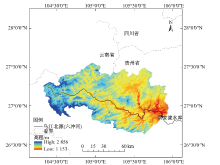
Fig.1
Location of the catchment of Hongjiadu Reservoir"
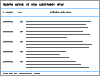
Tab.1
Areas and proportions of land-use in Hongjiadu Reservoir catchment from 2000 to 2020"
 |
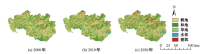
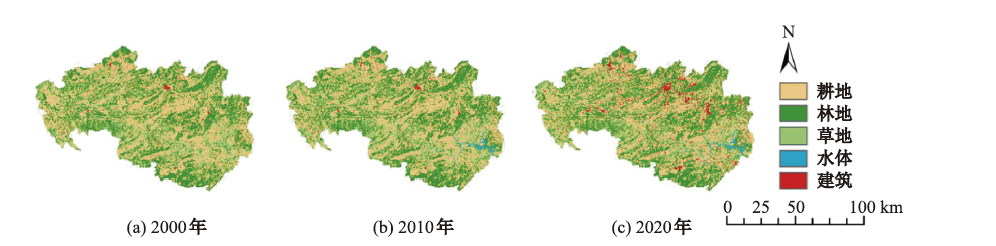
Fig.2
Spatial distribution maps of land-use in Hongjiadu Reservoir catchment from 2000 to 2020"
Tab.2
Change rangeability of land-use areas in Hongjiadu Reservoir catchment from 2000 to 2020"
 |
Tab.3
Land-use conversion matrix in the first stage after impoundment in Hongjiadu Reservoir catchment km$^{2}$"
 |
Tab.4
Land-use conversion matrix in the second stage after impoundment in Hongjiadu Reservoir catchment km$^{2}$"
 |
Fig.3
Land-use conversion matrix distributions in Hongjiadu Reservoir catchment from 2000 to 202"
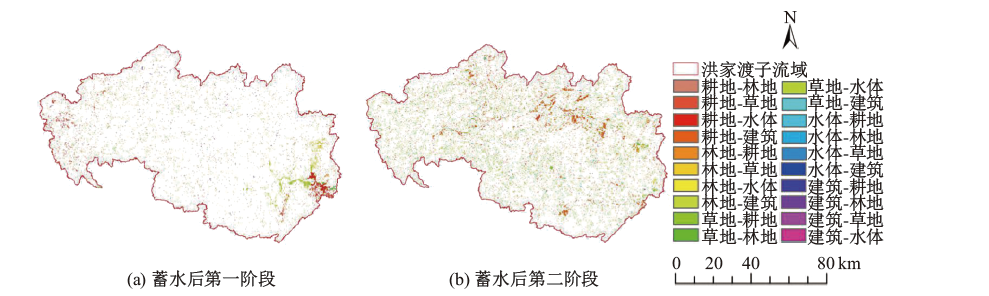
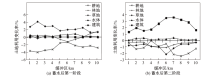
Fig.4
Percentage of land-use change coverage in Hongjiadu Reservoir 0--10 km buffer zone from 2000 to 2020"
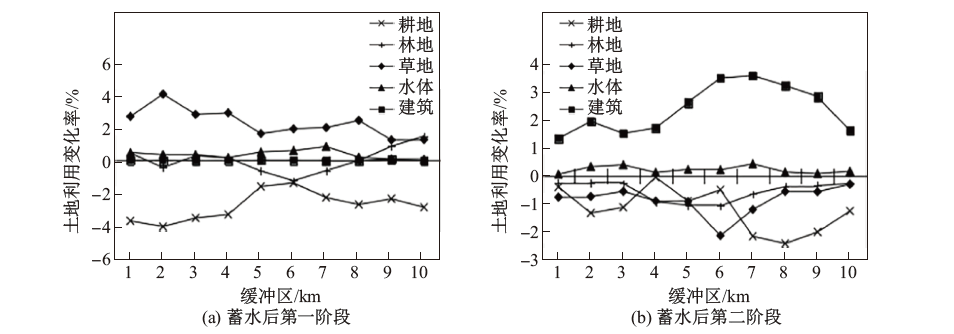
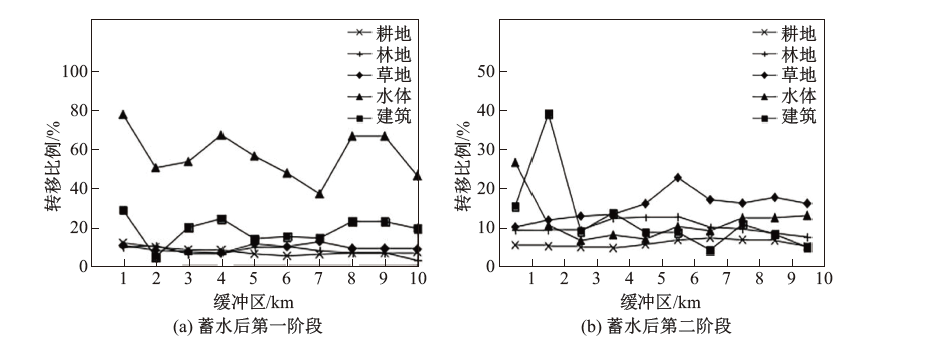
Fig.5
Percentage of land-use transfer areas in Hongjiadu Reservoir 0--10 km buffer zone from 2000 to 2020"
| [1] | Wei G L, Yang Z F, Cui B S, et al. Impact of dam construction on water quality and water self-purification capacity of the Lancang River, China[J]. Water Resources Management, 2009,23(9):1763-1780. |
| [2] | Lu X X, Oeurng C, Le T P, et al. Sediment budget as affected by construction of a sequence of dams in the lower Red River, Viet Nam[J]. Geomorphology, 2015,248:125-133. |
| [3] | Gehrke P C, Gilligan D M, Barwick M. Changes in fish communities of the Shoalhaven River 20 years after construction of Tallowa Dam, Australia[J]. River Research and Applications, 2010,18(3):265-286. |
| [4] |
Ezcurra E, Barrios E, Ezcurra P, et al. A natural experiment reveals the impact of hydroelectric dams on the estuaries of tropical rivers[J]. Science Advances, 2019. DOI: 10.1126/sciadv.aau9875.
pmid: 33888467 |
| [5] |
Mendonüa R, Müller R A, Clow D, et al. Organic carbon burial in global lakes and reservoirs[J]. Nature Communications, 2017,8:1694.
pmid: 29162815 |
| [6] |
Maavara T, Lauerwald R, Regnier P, et al. Global perturbation of organic carbon cycling by river damming[J]. Nature Communications, 2017,8:15347.
pmid: 28513580 |
| [7] | 李晓晴, 王伟, 操瑜, 等. 水库消落带碳氮输移转化研究进展 [J/OL]. [2021-03-19]. http://kns.cnki.net/kcms/detail/32.1118.P.20201105.1106.002.html. |
| Li X Q, Wang W, Cao Y, et al. Research advances in transport and transformation of carbon and nitrogen in water-level fluctuating zone (WLFZ) of reservoir [J/OL]. [2021-03-19]. http://kns.cnki.net/kcms/detail/32.1118.P.20201105.1106.002.html. | |
| [8] | Vannote R L, Minshall G W, Cummins K W, et al. The river continuum concept[J]. Canadian Journal of Fisheries and Aquatic Sciences, 1980,37:130-137. |
| [9] | Kelly V J. Influence of reservoirs on solute transport: a regional-scale approach[J]. Hydrological Processes, 2001,15(7):1-23. |
| [10] | 刘丛强, 汪福顺, 王雨春, 等. 河流筑坝拦截的水环境响应——来自地球化学的视角[J]. 长江流域资源与环境, 2009(4):86-98. |
| Liu C Q, Wang F S, Wang Y C, et al. Responses of aquatic environment to river damming: from the geochemical view[J]. Resources and Environment in the Yangtze Basin, 2009(4):86-98. | |
| [11] | Sun J Y, Hunter P D, Cao Y, et al. Response of terrestrial net primary productivity (NPPT) in the Wujiang catchment (China) to the construction of cascade hydropower stations[J]. Inland Waters, 2018,8(2):239-253. |
| [12] | Xu X B, Tan Y, Yang G S, et al. Impacts of China's Three Gorges Dam Project on net primary productivity in the reservoir area[J]. Science of the Total Environment, 2011,409(22):4656-4662. |
| [13] | 周涛, 程天雨, 虞宁晓, 等. 乌江中上游梯级水库氮磷滞留效应[J]. 生态学杂志, 2018,37(3):707-713. |
| Zhou T, Cheng T Y, Yu N X, et al. Nitrogen and phosphorus retention in cascade reservoirs along the upper reaches of Wujiang River[J]. Chinese Journal of Ecology, 2018,37(3):707-713. | |
| [14] | 王万发, 钟君, 李彩, 等. 喀斯特地区梯级水库建造对水化学分布的影响[J]. 湖泊科学, 2020,32(3):713-725. |
| Wang W F, Zhong J, Li C, et al. The influence of cascade reservoir construction on water chemistry distribution in karst area[J]. Journal of Lake Sciences, 2020,32(3):713-725. | |
| [15] | 王尧, 蔡运龙, 潘懋. 贵州省乌江流域土地利用与土壤侵蚀关系研究[J]. 水土保持研究, 2013,20(3):11-18. |
| Wang Y, Cai Y L, Pan M. Analysis on the relationship between soil erosion and land use in Wujiang River basin in Guizhou Province[J]. Research of Soil and Water Conservation, 2013,20(3):11-18. | |
| [16] |
Li Z W, Xu X L, Xu C H, et al. Dam construction impacts on multiscale characterization of sediment discharge in two typical karst watersheds of Southwest China[J]. Journal of Hydrology, 2018. DOI: 10.1016/j.jhydrol.2018.01.034.
doi: 10.1016/j.jhydrol.2018.10.038 pmid: 32020949 |
| [17] | 牛潜, 周旭, 许幼霞, 等. 基于土地利用的贵州省乌江流域生态系统服务价值演变分析[J]. 生态科学, 2018,37(5):165-173. |
| Niu Q, Zhou X, Xu Y X, et al. Analysis of ecosystem service value evolution of Wujiang River basin of Guizhou Province based on land use[J]. Ecological Science, 2018,37(5):165-173. | |
| [18] | 陈歆, 靳甜甜, 苏辉东, 等. 拉萨河河流健康评价指标体系构建及应用[J]. 生态学报, 2019,39(3):799-809. |
| Chen X, Jin T T, Su H D, et al. Construction and application of health assessment index system for Lhasa River[J]. Acta Ecologica Sinica, 2019,39(3):799-809. | |
| [19] | 张勇荣, 周忠发, 蒋翼, 等. 筑坝河流不同尺度土地利用结构对库区水质的影响——以平寨水库为例[J]. 水利水电技术, 2019,50(4):138-145. |
| Zhang Y R, Zhou Z F, Jiang Y, et al. Effects of multi-scale land use structure on water quality of damming rivers: a case study of Pingzhai Reservoir[J]. Water Resources and Hydropower Engineering, 2019,50(4):138-145. | |
| [20] | 李屹峰, 罗跃初, 刘纲, 等. 土地利用变化对生态系统服务功能的影响——以密云水库流域为例[J]. 生态学报, 2013,33(3):726-736. |
| Li Q F, Luo Y C, Liu G, et al. Effects of land use change on ecosystem services: a case study in Miyun Reservoir watershed[J]. Acta Ecologica Sinica, 2013,33(3):726-736. | |
| [21] | He X B, Wang M F, Tang Q, et al. Decadal loss of paddy fields driven by cumulative human activities in the Three Gorges Reservoir area, China[J]. Land Degradation $\&$ Development, 2020,31:1990-2002. |
| [22] | 李辉, 张晓媛, 国洪磊. 基于土地利用的三峡库区近 30 年生态系统服务价值时空变化特征[J]. 水土保持研究, 2021,28(2):309-318. |
| Li H, Zhang X Y, Guo H L. Spatial and temporal changes of ecosystem service value in the Three Gorges Reservoir area in the past 30 years based on land use[J]. Research of Soil and Water Conservation, 2021,28(2):309-318. | |
| [23] | 徐丰, 曹宏, 廖章志. 遥感技术在开发建设项目水土保持监测中的应用——以洪家渡水电站为例[J]. 中国水土保持, 2008(3):42-44, 64. |
| Xu F, Cao H, Liao Z Z. Application of remote sensing technique to the monitoring of soil and water conservation of development projects[J]. Soil and Water Conservation in China, 2008(3):42-44, 64. | |
| [24] | 喻元秀, 刘丛强, 汪福顺, 等. 洪家渡水库溶解二氧化碳分压的时空分布特征及其扩散通量[J]. 生态学杂志, 2008(7):1193-1199. |
| Yu Y X, Liu C Q, Wang F S. Spatiotemporal characteristics and diffusion flux of partial pressure of dissolved carbon dioxide (pCO$_2$) in Hongjiadu Reservoir[J]. Chinese Journal of Ecology, 2008(7):1193-1199. | |
| [25] | 刘纯军, 周国富, 黄启芬, 等. 基于地形梯度的贵州乌江流域土地利用时空演变分析[J]. 贵州师范大学学报(自然科学版), 2020,38(6):45-54. |
| Liu C J, Zhou F G, Huang Q F, et al. Spatial-temporal evolution of land use in Wujiang River basin in Guizhou Province based on the terrain gradient[J]. Journal of Guizhou Normal University (Natural Sciences), 2020,38(6):45-54. | |
| [26] | 刘纯军, 周国富, 黄启芬, 等. 基于 InVEST 模型的西南山地流域生境质量时空分异—— 以贵州赤水河流域为例 [J/OL]. [2021-03-19]. http://kns.cnki.net/kcms/detail/42.1202.TV.20210204.1836.002.html. |
| Liu C J, Zhou F G, Huang Q F, et al. Spatio-temporal evolution analysis of habitat quality in the mountainous watershed of southwest based on InVEST model: a case study of Chishui River basin in Guizhou Province [J/OL]. [2021-03-19]. http://kns.cnki.net/kcms/detail/ 42.1202.TV.20210204.1836.002.html. | |
| [27] | 王业春, 雷波, 张晟. 三峡库区消落带不同水位高程植被和土壤特征差异[J]. 湖泊科学, 2012,24(2):206-212. |
| Wang Y C, Lei B, Zhang C. Differences in vegetation and soil characteristics at different water-level altitudes in the drawdown areas of Three Gorges Reservoir area[J]. Journal of Lake Science, 2012,24(2):206-212. | |
| [28] | Shields J F, Andrew S, Lyle J S. Reservoir effects on downstream river channel migration[J]. Environmental Conservation, 2000,27(1):54-66. |
| [1] | ZHANG Li, SONG Yichao, PU Yunzhu, NI Congcong, DENG Ning, HUANG Xin. Analysis of the effects and mechanism of algae barrier interception in water source sites [J]. Journal of Shanghai University(Natural Science Edition), 2026, 32(2): 324-332. |
| [2] | XUE Peiyu, GU Chunyuan, LI Yuhua, ZHU Junjie. Enhanced imbibition effect of nanofluids and driving characteristics of oil drainage in fractured ultra-low permeability reservoirs [J]. Journal of Shanghai University(Natural Science Edition), 2026, 32(1): 54-66. |
| [3] | HUANG Jiaqi, LIN Xin, WANG Fushun, MA Jing. Characteristics of lignin in sediment cores from cascade reservoirs downstream of the Wujiang River and[1mm] source analysis of organic carbon [J]. Journal of Shanghai University(Natural Science Edition), 2021, 27(2): 271-279. |
| [4] | GUAN Tianhao, LI Xiaodong, WANG Yiyao, YANG Mengdi, CUI Gaoyang, DING Shiyuan, ZHANG Xuecheng. Distribution characteristics, influencing factors and sources of heavy metals in karst deep-water reservoirs: a case study of Longtan Reservoir [J]. Journal of Shanghai University(Natural Science Edition), 2021, 27(2): 236-249. |
| [5] | MEI Lin, FAN Xinyi, YUE Yihong, LIU Liu, CHU Yongsheng, WANG Fushun. Rapid determination of TOC, TN and BSi content in reservoir sediments based FTIR [J]. Journal of Shanghai University(Natural Science Edition), 2021, 27(2): 227-235. |
| [6] | ZHANG Jinhua, HUANG Jiaqi, LIN Xin, WANG Fushun, MA Jing. Spatial and seasonal variability of particulate organic carbon in the Wujiang River [J]. Journal of Shanghai University(Natural Science Edition), 2021, 27(2): 250-259. |
| [7] | SU Qingqing, LI Chunrong, WANG Xianyun, ZHANG Dong, HUANG Xin. Quantification of dominant algal species in water reservoir by measuring two-dimensional projection characteristic values of algal clusters [J]. Journal of Shanghai University(Natural Science Edition), 2020, 26(6): 980-988. |
| [8] | Ye LIU, Yujie WANG, Fushun WANG, Xia LIANG, Xueping CHEN, Ming YANG, Jing MA. Occurrence, sources and ecological risk assessment of polycyclic aromatic hydrocarbons in surface sediments from Xin'anjiang River-reservoir system [J]. Journal of Shanghai University(Natural Science Edition), 2020, 26(1): 113-122. |
| [9] | WEI Haobin1, WU Xueqian1, CAO Man1, FU Jianan1, JIA Xiaobin1, DENG Bing2, WANG Fushun1. Partial pressure and diffusion flux of dissolved carbon dioxide in mainstream and tributary (Zhuyi River) of the Three Gorges Reservoir in summer [J]. Journal of Shanghai University(Natural Science Edition), 2016, 22(4): 497-504. |
| [10] | ZHU Yangsheng1,2, SONG Xuehang2, GUO Yintong3, XU Feng3, SUN Nannan2, WEI Wei2,4, CHEN Zhiwen1. Characteristics and pore structures of shale reservoir rocks in eastern and southeastern Chongqing of China [J]. Journal of Shanghai University(Natural Science Edition), 2016, 22(2): 246-260. |
| [11] | WU Xue-Qian, CAO Man, FU Jia-Nan, WEI Hao-Bin, JIA Xiao-Bin, DENG Bing, WANG Fu-Shun. Partial pressure and diffusion flux of dissolved carbon dioxide in the main stream of the Three Gorge Reservoir and the Caotang River in summer [J]. Journal of Shanghai University(Natural Science Edition), 2015, 21(03): 311-318. |
| [12] | LIU Xiao-Long, WANG Fu-Shun, BAI Li, LI Si-Liang, WANG Bao-Li, LIU Cong-Jiang, WANG Zhong-Liang. Impact of cascade reservoir development on N2O emissions in the Wujiang River [J]. Journal of Shanghai University(Natural Science Edition), 2015, 21(03): 301-310. |
| Viewed | ||||||
|
Full text |
|
|||||
|
Abstract |
|
|||||

