仿猛禽无人机稳态栖息建模及抓取腿爪设计

展开
  • 上海工程技术大学 机械与汽车工程学院, 上海 201620
许 勇 (1973—), 男, 教授, 硕士生导师, 博士, 研究方向为机器人机构学.

收稿日期: 2023-08-28

  网络出版日期: 2024-09-15

基金资助

上海市自然科学基金面上项目 (21ZR1426000)

Steady-state perching modeling and grasping leg/claw design of bionic raptor robot

Expand
  • School of Mechanical and Automotive Engineering, Shanghai University of Engineering Science, Shanghai 201620, China

Received date: 2023-08-28

  Online published: 2024-09-15
摘要

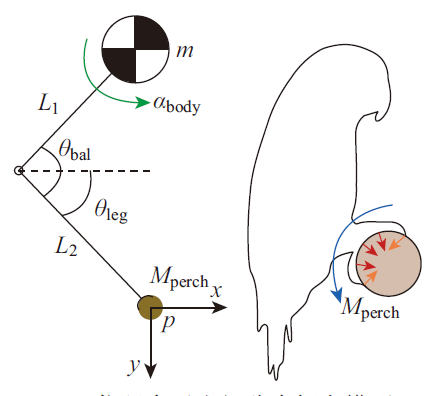
目前, 带臂爪无人机对形状复杂物体的抓取、栖息能力仍然有限, 针对这一问题提出了一种可与无人机本体集成、在非结构化环境中具备可靠抓握和稳定栖息能力的仿猛禽无人机.在建立仿猛禽无人机的稳态栖息模型时, 求解得到了具有最小倾覆力矩的腿部最优尺寸; 建立了无人机的角动量和线动量模型, 求解获得了满足倾覆力矩和动量约束、由质心速度角-质心速度-腿角 3 维参数组合生成的栖息成功参数域; 设计了可将瞬时碰撞能量被动转化为强大抓握力、通过自锁来被动保持可靠抓握状态的欠驱动抓握腿爪; 完成了无人机样机栖息实验, 且实验和仿真的参数变化规律一致, 变化连续平稳. 上述成果证实了该稳态栖息模型、动量模型及无人机结构设计方案的合理性, 为后续实现仿猛禽栖息无人机的位姿实时控制, 以及无人机在遥感探测、搜救避险、环境监测等非结构化环境中的广泛应用提供了理论和方法指导.

本文引用格式

许 勇, 郭书言, 魏馨梅 . 仿猛禽无人机稳态栖息建模及抓取腿爪设计[J]. 上海大学学报(自然科学版), 2024 , 30(4) : 704 -720 . DOI: 10.12066/j.issn.1007-2861.2564

Abstract

To solve the limitations in the abilities of aerial robots with legs/claws in grasping and perching on complex objects, a bionic raptor robot that can be integrated with a robot body and has the ability to reliably grasp and maintain stable perching in unstructured environments was presented in this paper. In this study, a steady-state perching model of a robot was established, and the optimal leg sizes with the minimum overturning moment were obtained. Angular momentum and linear momentum models of the robot were established, and a successful perching parameter domain satisfying the overturning moment and momentum constraints, which were generated by a combination of the three-dimensional parameters of the centroid velocity angle, centroid velocity, and leg angle, was obtained. A pair of under-actuated grasping legs/claws was designed to passively transform instantaneous impact energy into a strong grasping force and passively maintain a reliable grasping state by self-locking. In the perching experiments and perching motion simulations of this robot prototype, the kinematic parameters changed consistently and steadily. The above achievements confirm the rationality of the steady-state perching model, momentum model, and robot structural design scheme proposed in this study and lay theoretical and methodological foundations for the subsequent realization of the real-time position control of a bionic raptor perching robot and its wide applications in remote sensing, search and rescue, and environmental monitoring in unstructured environments.
文章导航

/