在冻融条件下云冈石窟砂岩风化现象严重, 为深入了解砂岩在冻融作用下的物理力学
特性损伤与风化程度变化, 针对云冈石窟砂岩开展了室内冻融循环模拟风化试验. 在饱和条件
下通过设置不同冻融循环次数得到不同风化程度的砂岩, 采用实验室内多种原位宏观无损检
测技术对循环前以及每 5 次循环后的砂岩进行测试, 得到砂岩在冻融循环过程中的破坏特征
以及各物理力学特性参数. 结合微观检测技术从细观角度探讨了砂岩内部结构损伤机制及性
能指标变化原因, 并根据波速比值变化判断砂岩风化程度. 试验结果表明, 砂岩风化特征表现
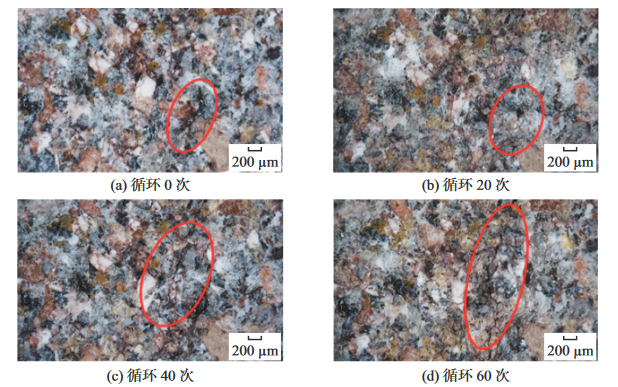
为颗粒脱落, 结构逐渐破坏并产生裂隙, 砂岩风化程度逐渐加深, 经 60 次循环试验后砂岩达到
中等风化程度. 多种检测方法的测试结果均表现出一定的规律性: 砂岩的质量、超声波速、硅、
钙元素含量、抗压强度等均随冻融循环次数的增加而降低; 砂岩孔隙率随冻融循环次数的增加
而增大; 砂岩冻融循环次数、超声波速以及抗压强度之间存在一定的关联性, 建立了三者数值
关系式并可直接应用.
Weathering of Yungang Grottoes sandstone is significant under freeze-thaw conditions. To understand the change of damage and weathering degree of sandstone under
freeze-thaw, this study simulates the weathering process of Yungang Grottoes sandstone by
indoor freeze-thaw cycle tests. Sandstone with different weathering degrees can be obtained by setting different freeze-thaw cycle times under saturated conditions. Before the start of
cycles and after every 5 cycles, a number of macroscopic nondestructive testing techniques
are used to test the sandstone. Subsequently, the failure characteristics, and changes of
physical and mechanical properties of sandstone during the freeze-thaw cycle are obtained.
The damage mechanism of internal structure and the reason of property index change are
discussed from the macroscopic perspective by combining with microscopic detection technology. Moreover, the weathering degree of sandstone is determined according to the wave
velocity ratio. The results indicate particle disintegration of sandstone, which results in
the gradual destruction of the structure forming cracks. In addition, the weathering degree of sandstone gradually deepens and the sandstone reaches medium weathering degree
after 60 cycles. The results of various detection methods indicate certain regularity: the
mass, ultrasonic wave velocity, content of Si and Ca, and compressive strength of sandstone
decrease with the increase of freeze-thaw cycles, and the pores of the sandstone are increasing. It is found that a specific correlation exists between the number of freeze-thaw cycles,
ultrasonic wave velocity, and compressive strength of sandstone. The formula between the
three values is established and can be directly applied.