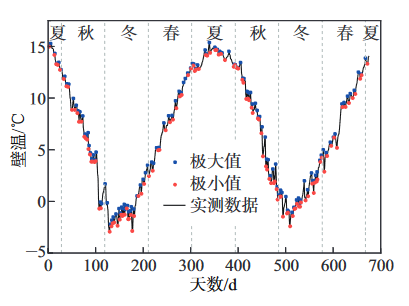
环境参数会直接影响石窟的风化过程, 因此, 预测环境参数是进行云冈石窟有效保护
的重要内容. 以云冈石窟第十窟为例, 将壁温、环境湿度、环境温度的实测时序数据作为环境
参数, 使用经验模态分解 (empirical model decomposition, EMD) 对实测时序数据进行分解,
研究了固有模态函数 (intrinsic mode function, IMF) 分量与实测时序数据的相关性, 建立了
基于 EMD-长短期记忆 (long short-term memory, LSTM) 的人工神经网络 (artificial neural
network, ANN) 组合模型. 使用平均绝对误差 (mean absolute error, MAE)、均方根误差
(root mean square error, RMSE)、平均绝对百分比误差 (mean absolute percentage error,
MAPE)、决定系数 (R2) 作为评价指标, 对比分析了使用组合模型与使用单一 LSTM 的 ANN
模型进行环境参数预测的效果. 结果表明: IMF 分量的变化速率越大, 与实测时序数据的相
关性就越强; 对于组合模型中的 LSTM 网络模型, 当隐藏层层数和初始学习率分别取 2 和
0.001 时, 组合模型预测效果最优; 与单一 LSTM 的 ANN 模型相比, 使用基于 EMD-LSTM
的 ANN 组合模型, 环境参数的 MAE、RMSE、MAPE 值减小、R2 值增大, 模型预测精度提
高; 环境参数预测效果主要受环境参数变化幅度的影响, 变化幅度越小, 组合模型预测效果越
好. 研究成果对于石窟文物保护具有一定的参考价值.
The weathering process of grottoes is directly influenced by environmental parameters. Consequently, estimating these parameters is important for the effective preservation of Yungang Grottoes. This research utilized measured time-series data of wall
temperature, environmental humidity, and temperature from the 10th grotto of Yungang
Grottoes. These data were decomposed into various components using empirical mode decomposition (EMD). Correlations between the measured time-series data and intrinsic
mode function (IMF) components were also investigated. A combined model, based on the
EMD-long short-term memory (LSTM) artificial neural network (ANN), was then developed. Using mean absolute error (MAE), root mean square error (RMSE), mean absolute
percentage error (MAPE), and R2 as the evaluation indices, comparisons were made be-
tween the recorded environmental parameters and those estimated by the combined model
and standalone LSTM-based ANN. The findings suggested that as the rate of change in
the IMF components increased, the correlation between the IMF components and measured time-series increased. When only employing the LSTM-based ANN, optimal results
were obtained with 2 hidden layers and an initial learning rate of 0.001. Conversely, when
using the combined model, MAE, RMSE, and MAPE values decreased, while R2 values in-
creased, indicating the improved estimation efficiency. The accuracy of the environmental
parameter estimations largely depended on the extent of parameter changes, with smaller
changes leading to better model efficiency. The insights gained from this research can be
useful for the preservation of cultural relics of grottoes.