随着城市地下空间的快速发展, 人工冻结法已经广泛应用于地铁联络通道的施工过程,
但针对含盐粉砂层中的联络通道冻结法在地下水流作用下的机理尚不明确, 导致原计划冻结
时间的延长. 以人工冻结法为研究背景, 提出了冻结过程中水流-盐分共同作用下的耦合分析
方法. 首先, 基于多孔介质传热、Darcy 定律和 Fick 定律, 建立了水-热-盐三场耦合的物理数
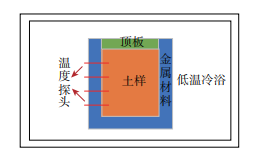
学方程; 然后, 利用有限元软件 COMSOL Multiphysics 模拟含盐土体的冻结模型试验, 并与
模型试验结果进行对比分析, 验证了本方法的有效性; 最后, 将本方法应用于南通地铁 1 号线
永兴大道站—深南路站区间 4#联络通道冻结法施工过程模拟, 并相应开发了一套多物理场数
据监测设备, 将模拟结果与监测数据进行对比分析. 结果表明, 含盐土体比不含盐土体降温更
慢, 盐分浓度越大, 降低同样温度所需时间越长; 水头差导致冻结壁呈非对称状, 上游冻结壁厚
度小于下游冻结壁厚度; 通过对冻结壁厚度和平均温度的计算, 模拟冻结 45 d 达不到设计要
求, 需要冻结 50 d. 保证了南通地铁 1 号线联络通道人工冻结法施工的安全, 并提供了一种在
复杂环境条件下冻结施工的多场耦合分析方法.
Owing to the rapid development of urban underground space, the artificial
freezing method has been widely used in the construction of subway-tunnel connecting
channels. However, the mechanism of the freezing method as a joint result of water seepage and saline soil remains unclear. Hence, the originally planned freezing time is extended.
A multifield coupling analysis under the interaction of water seepage and salt in the freezing
process is proposed. The No.4 connection channel between Yongxing Avenue Station and
Shennan Road Station of the Nantong Urban Rail Transit Line 1 is the research object in
this study. First, based on heat transfer theory, as well as water seepage and salt migration in porous media, the physical-mathematical equation of the water-thermal-salt coupling
method is established. Second, the finite element software COMSOL Multiphysics is used
to simulate the freezing model test of saline soil mass, and the results of the model test
are verified. Finally, the method above is applied to the construction simulation of the
connecting-channel freezing method. A multiphysical field data monitoring equipment is
designed, and the simulation and actual monitoring data are compared. The results show
that the temperature of saline soil varies more slowly than that of non-saline soil. Ad�ditionally, a higher salt concentration in the soils implies a longer time required for their
temperature to decrease to the same temperature. Moreover, the water head difference
results in an asymmetrical frozen wall, and the thickness of the frozen wall upstream is
smaller than that downstream. By calculating the thickness and average temperature of
the frozen wall, it is discovered that the simulated freezing for 45 days does not satisfy
the design requirements, and that the freezing time reaches 50 days. This study shows
that safety is guaranteed when the freezing method is used in the connecting channel of
Nantong Urban Rail Transit Line 1. The freezing method is a multifield coupling method
that can be used under complex environmental conditions.