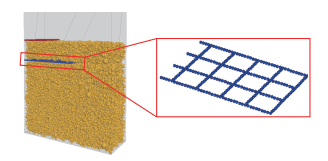
格栅加筋地基是在基础下一定深度范围内铺设适当的土工格栅, 以此来改善地基承载
性能的地基处理形式. 基于模型试验, 采用三维颗粒流软件 (3D particle flow code, PFC3D)
模型, 建立了条形基础下格栅加筋地基的颗粒流数值模型. 通过分析地基中整体应力分布、砂
土颗粒位移、砂土颗粒接触力、筋材变形及筋土相互作用等, 研究了条形基础下格栅加筋地基
的承载性能和细观加固机理. 结果表明: 在条形基础下, 格栅能较好地均化上覆条形荷载; 格
栅主要发挥加筋作用的长度约为 1.3∼1.5 倍基础宽度. 格栅加筋地基的主要加固机理为格栅
网孔结构的嵌固作用. 嵌固作用使得颗粒与格栅协同作用形成一个整体, 并进行应力重分布,
进而提高整体格栅加筋地基的承载性能. 此外, 水平格栅的横肋对土体的阻挡力是导致纵肋产
生拉力的主要原因. 在条形上覆荷载下, 格栅的变形存在一个反弯点. 格栅对反弯点一侧的土
体产生向上的作用力, 对反弯点另一侧的土体产生向下的作用力. 格栅的张拉膜效应调节了整
体地基的不均匀沉降.
The geogrid reinforced foundation is a foundation treatment method to improve
the bearing capacity of the foundation by laying appropriate geogrids at a certain depth
under the footing. Based on model tests, a 3D particle flow code (PFC3D) was applied to
simulate the geogrid reinforced foundation under strip footing. The bearing capacity and
the reinforcement mechanism of the geogrid reinforced foundation were investigated by analyzing stress distribution, sand particle displacement, sand particle contact force, geogrid
deformation and geogrid-sand interaction, et al. The results demonstrated that a more uniform loading was applied on the foundation by using the geogrid reinforcement, and
the effective reinforcement length was approximately 1.3~1.5 times of the footing width.
The primary reinforcement involved surrounding soil materials to interlock across the geogrid plane. This interlocking enhanced passive resistance, rendering the geogrid-reinforced
foundation more integral. Consequently, stress redistribution occurred, leading to an improvement in bearing capacity. In addition, the lateral restraint of the transverse ribs was
the main reason for inducing a tensile force in the longitudinal ribs. The deformation of
geogrid had a reverse bending point under the applied loading. An upward and downward
force was applied to the sand particles at the two sides of the reverse bending point, respectively. The tension membrane mechanism of the geogrid decreased the uneven settlement
in the overall geogrid reinforced foundation.