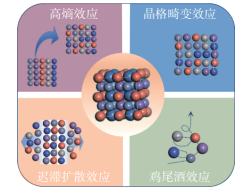
高熵材料 (high-entropy material, HEM) 是一类具有良好性能的新型材料, 以其较好的催化潜力、耐腐蚀性能等特点受到广泛关注. 传统的高熵催化剂研究大多局限于各自的知识体系, 难以兼容合并, 不利于更优异的催化剂的后续研发. 机器学习 (machine learning,
ML) 作为一种基于大数据集来建立数理模型、进行研究推理的新兴学科, 正逐步成为人们重点关注的人工智能科学分支. 通过机器学习建立大数据库可以有效改善传统的研究状况, 使研究效率大为提高. 机器学习能用于识别定量的组分-结构-性能关系, 通过从历史数据中学习而无需通过显式编程来加速电催化剂的设计. 对机器学习算法、高熵材料进行了介绍, 并阐述了机器学习在设计高熵电催化剂中的应用, 讨论了机器学习在高熵电催化剂筛选和预测方面的发展前景.
As a new class of materials with excellent properties, high-entropy materials
(HEMs) have attracted wide interests, in the scientific community owing to their excellent
catalytic potential and corrosion resistance. Most traditional studies on high-entropy
catalysts are carried out independently, based on existing knowledge systems, which are
incompatible and cannot be merged. This has hindered subsequent research and development
of better catalysts. Machine learning (ML), as a new strategy to establish mathematical
models and conduct research and reasoning based on large data sets, is gradually
becoming a branch of artificial intelligence science. The establishment of large databases
through ML can effectively transform the traditional research landscape and considerably improve research efficiency. ML can be employed to identify quantitative compositionstructure-performance
relationships, providing a novel approach to accelerate the design
of electrocatalysts by learning from historical data without explicit programming. This
review introduces ML algorithms and HEMs, and it describes and analyses the application
of ML in the design of high-entropy electrocatalysts. Finally, the prospects of ML in the
screening and prediction of electrocatalysts are discussed and summarised.