利用五氯化铌 (niobium pentachloride, NbCl5) 对碳化后的蜜胺泡绵 (melamine
foam, MF) 进行活化处理, 实现杂原子富集, 再进行热处理, 获得多原子掺杂的蜜胺泡绵基碳
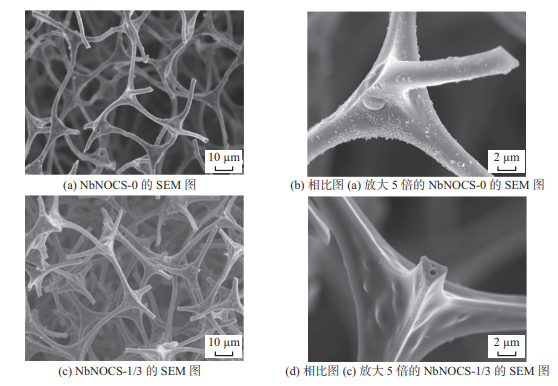
海绵 (NbNOCSs). NbNOCSs 具有良好的自支撑三维网状结构, 可直接用作单片电极, 无需
任何添加剂. 实验结果表明, NbCl5 的活化对提高 NbNOCSs 电极的电化学性能有着重要作
用. 与未经 NbCl5 活化的 NbNOCS 相比, NbNOCS-1/3 (NbCl5 与一次碳化的 MF 的质量
比为 1∶3) 因其独特的孔隙结构、丰富的赝电容活性物质和良好的离子转移特性而表现出更
优异的电化学性能. NbNOCS-1/3 在电流密度为 0.5 A·g
−1 时表现出 173.4 F·g
−1 的高比电
容; 在 50 A·g
−1 时有 59.49% 的高容量保持率; 在 10 A·g
−1 电流密度下循环 10 000 次后仍
有 90.78% 的容量保持率, 显示出良好的电化学循环性能.
The carbonized melamine foam (MF) was activated by niobium pentachlo�ride (NbCl5) to enrich heteroatoms to obtain polyatomic doped melamine foam-based
carbon sponges (NbNOCSs) by heat treatment. NbNOCSs have a good self-supporting
three-dimensional network structure. They can be directly used as monolithic electrodes
without any additives. The results show that the activation of NbCl5 plays an important
role in improving the electrochemical properties of NbNOCSs electrodes. Compared with
NbNOCS without NbCl5 activation treatment, NbNOCS-1/3 (NbCl5/MF with a primary
carbonization weight ratio of 1∶3) shows better electrochemical performance due to its
unique pore structures, rich pseudocapacitive active species, and good ion transfer charac�teristics. Moreover, it exhibits a high specific capacitance (173.4 F·g
−1
at a current density
of 0.5 A·g
−1
) and high capacitance retention (59.49% at 50 A·g
−1
), as well as a good elec�trochemical cyclability (90.78% after 10 000 cycles at 10 A·g
−1
).