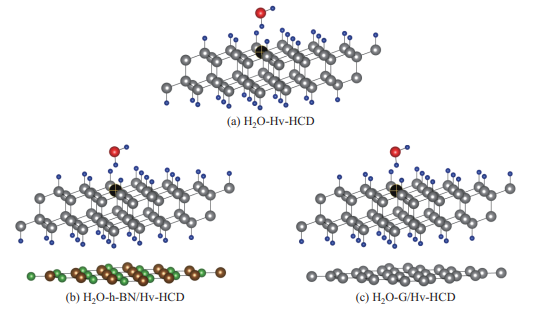
基于立方金刚石晶体结构构建了 2 种 2 维原子晶体: 氢化立方金刚石 (hydrogenated cubic diamond, HCD) 和含氢空位氢化立方金刚石 (hydrogen vacancy-HCD, Hv-HCD); 将含氢空位氢化立方金刚石与单层六方氮化硼 (h-BN) 和石墨烯 (graphene, G) 组装构建了 2种 2 维原子晶体范德华异质结构: h-BN/Hv-HCD 和 G/Hv-HCD. 根据第一性原理, 对含氢空位氢化立方金刚石 2 维原子晶体体系、硫酸吲哚酚和水分子的 Fukui 函数进行了计算. 研究结果显示, 含氢空位氢化立方金刚石 2 维原子晶体体系的氢空位碳原子具有较大的 f+(r)和 f−(r) 值, 表明氢空位碳原子的亲电和亲核反应趋势较为显著. 有关能量效应的计算结果表明: 水分子与含氢空位氢化立方金刚石2 维原子晶体体系的氢空位碳原子形成氢键; 硫酸吲哚酚分子在氢空位碳原子位点发生化学分解, 生成 3-吲哚酮和二氧化硫, 原磺酸基羟基与氢空位碳原子结合形成醇羟基. 该体系可以作为基于2 维原子晶体研发生物活性分子、人体血液毒素分子吸附清除以及检测分析核心材料的参考依据.
The aim of this study was to construct hydrogenated two-dimensional cu-bic atomic diamonds with hydrogen vacancy-hydrogenated cubic diamond (Hv-HCD) and without hydrogen vacancy (HCD). Furthermore, the isolated monolayer of hexagonal boron nitride (h-BN) or graphene (G) and Hv-HCD were reassembled into van de Waals het-erostructures, h-BN/Hv-HCD, and G/Hv-HCD. Based on first-principles, the Fukui func-tions of water, indoxyl sulfate, and the constructed hydrogenated two-dimensional cubic atomic diamonds with hydrogen vacancy were calculated. The largest values of f+(r) and f−(r) lie around the carbon atom close to the hydrogen vacancy, implying that the carbon atom was the nucleophilic and electrophilic reactive site. The results indicate that a water molecule forms a hydrogen bond with the carbon atom close to the hydrogen vacancy of the hydrogenated two-dimensional atomic diamonds with hydrogen vacancy. The indoxyl phosphate molecule is degraded into 3-indolone and sulfur dioxide at the carbon atom close to the hydrogen vacancy site. The hydroxyl in the sulfonic group forms an alcoholic hy-droxyl with the carbon atom close to the hydrogen vacancy. The phenomena described here could provide a foundation for investigating the essential materials for the development of bioactive or human blood toxic molecule sensors based on two-dimensional atomic crystals.