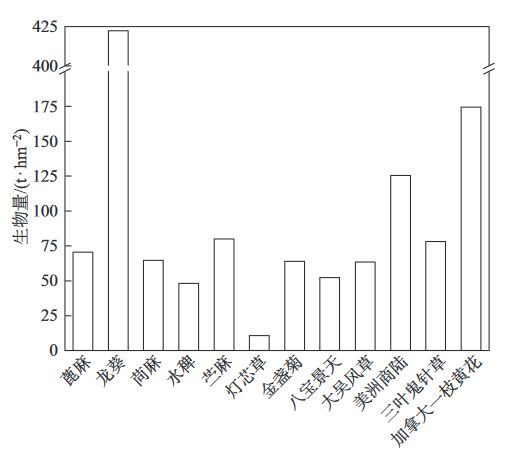
选用 12 种植物对上海市某 Cd 污染黑臭河道底泥进行了修复试验研究, 考察了修复植
物对 Cd 污染底泥的耐受性、富集转运特性和修复效果, 以期为实际开展植物修复 Cd 污染河
道底泥研究提供科学依据. 结果表明: 除移植的灯芯草 (Juncus effusus L.) 生长情况较差外,
其余 11 种植物对试验底泥均有良好的耐受性; 龙葵 (Solanum nigrum L.)、灯芯草、金盏菊
(Calendula officinalis L.)、八宝景天 (Hylotelephium erythrostictum (Miq.) H. Ohba) 以及
大吴风草 (Farfugrium japonicum (L. f.) Kitam.) 地上部分的 Cd 质量比均高于 4.50 mg/kg;
苘麻 (Abutilon theophrasti Medicus)、灯芯草、金盏菊、八宝景天、大吴风草以及美洲商陆
(Phytolacca americana L.) 对 Cd 的富集系数 (bioaccumulation factor, BCF) 与转运系数
(translocation factor, TF) 均大于 1; 龙葵、金盏菊、美洲商陆以及三叶鬼针草 (Bidens pilosa
L.) 对 Cd 的提取量均高于 0.30 kg/hm2, 具有较好的修复效果, 其中龙葵对试验底泥中 Cd
的提取量为 2.84 kg/hm2, 提取效率可达 88.75%, 展现出了较大的修复潜力. 优选试验结果证
明, 龙葵可作为该地区 Cd 污染河道底泥的最佳修复植物.
Twelve plants were selected to conduct an experimental study on remediation
of Cd contaminated sediment of black-odor river in Shanghai. Tolerance, enrichment and
translocation features, and remediation efficiencies of plants to the heavy metal were investigated, with a view to find practical application of phytoremediation of river sediments polluted by Cd. Results revealed that all the plants except the transplanted Juncus effusus L.
showed good tolerance to the sediment. The above-ground Cd contents of Solanum nigrum
L., Juncus effusus L., Calendula officinalis L., Hylotelephium erythrostictum (Miq.) H. Ohba, and Farfugrium japonicum (L. f.) Kitam. were higher than 4.50 mg/kg. The bioaccumulation factors (BCFs) and translocation factors (TFs) of Cd in Abutilon theophrasti
Medicus, Juncus effusus L., Calendula officinalis L., Hylotelephium erythrostictum (Miq.)
H. Ohba, Farfugrium japonicum (L. f.) Kitam. and Phytolacca americana L. were greater
than 1. The extraction amounts of Cd in Solanum nigrum L., Calendula officinalis L.,
Phytolacca americana L. and Bidens pilosa L. were higher than 0.30 kg/hm2, and had
relatively good remediation effects. Among the plants, the extraction amount and extraction efficiency of Solanum nigrum L. for Cd in the sediment were up to 2.84 kg/hm2 and
88.75%, respectively, indicating great remediation potential. The optimization test proved
that Solanum nigrum L., as the best remediation plant, could be used to remediate the Cd
contaminated river sediment in this area.