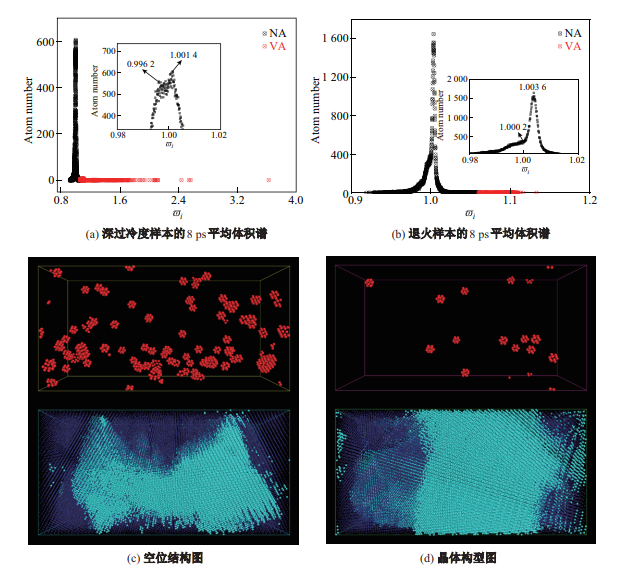
采用不同的分子动力学(molecular dynamics, MD) 技术模拟了密排六方(hexagonal close-packed, HCP) 金属Mg 在深、中、浅过冷度条件下的凝固及退火过程, 并利用新建的时间平均原子体积谱(time-averaged atomic volume spectrum, TAVS) 方法对空位进行了标定分析. 结果表明: 凝固过程中的空位捕获效应非常明显, 即过冷度越大, 捕获空位的浓度就越高, 且远高于对应的平衡空位浓度. 同时发现, HCP-Mg 在凝固过程中存在一定量的自间隙原子. 这与对称性更高的面心立方(face-centered cubic, FCC) 金属Al 完全不同. 此外, HCP-Mg 的空位原子(vacancy atoms, VA) 笼存在外扩位移, 而不是目前普遍公认的金属空位原子的内缩位移.
Different molecular dynamics (MD) techniques were used to simulate the solid-ification and annealing processes of hexagonal close-packed (HCP) metal Mg under deep, medium, and shallow undercooling conditions. A newly constructed time-averaged atomic volume spectrum (TAVS) method was then utilized to locate and analyse the trapped va-cancies. The results showed that the vacancy trapping effect worked dramatically during solidification, meaning that the greater the degree of undercooling, the higher was the con-centration of trapped vacancies. In addition, the trapping concentration was much higher than the corresponding equilibrium concentration. Moreover, it was found that HCP-Mg had a certain number of self-interstitial atoms during the solidification process, which con-trasted fully with the more symmetrical face-centred cubic (FCC) metal Al. Finally, the atomic cage of vacancy in HCP-Mg featured a remarkable outward displacement instead of the generally accepted inward displacement of vacancy atoms (VA) in metals.