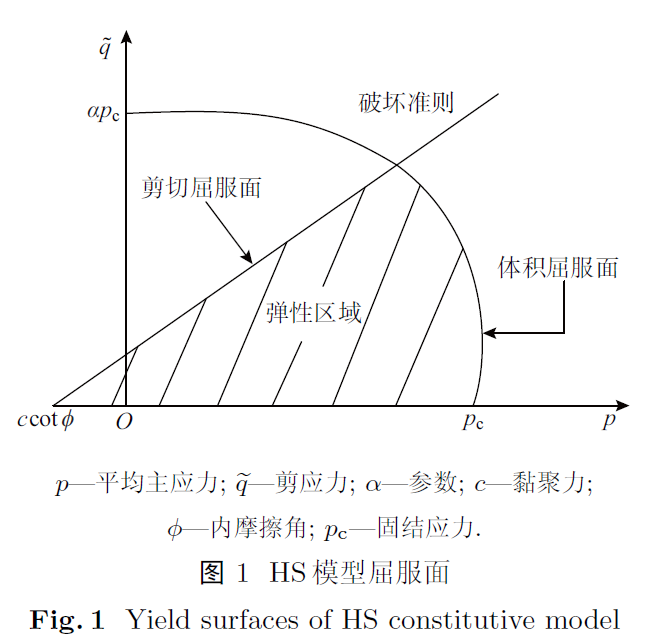
为了准确模拟岩土介质的加/卸载力学特征, 引入了硬化土及小应变本构模型. 从屈服函数、硬化规律、塑性势函数、流动法则及小应变刚度方面介绍了程序的开发流程, 利用VC++ 语言编译了动态链接库, 实现了在FLAC3D 3.0 中的加载和调用. 通过与小应变模型开发经典案例的试验结果对比, 验证了小应变硬化土模型的合理性. 以上海绿洲中环中心深基坑工程为例, 分别采用硬化土本构模型、小应变模型和Mohr-Coulomb 理想弹塑性模型进行对比研究, 硬化土及小应变模型的应力、变形分析结果与实际监测数据更为接近. 研究结果可以为变形控制为主的大型地下工程开发提供可靠的岩土力学分析方法.
A constitutive model of hardening soil and small-strain-hardening soil was established to simulate the loading–unloading characteristics accurately. Mathematical equations for the constitutive models of the hardening and small-strain-hardening soils were de-rived using the yield function, plastic potential function, and flow law. Dynamic-link data were compiled using the VC++ language, and the loading and invoked interfaces were modelled using FLAC3D 3.0. Test results for classical cases of small-strain model development were compared to verify the rationality of the hardening soil model with small-strain stiff-ness. The constitutive model was used to simulate the deep foundation excavation of the Oasis Center in Shanghai, and the actual measurement results were compared with those of the small-strain-hardening soil, hardening soil, and Mohr–Coulomb ideal elastic–plastic models. The analysed data of the hardening and small-strain-hardening soil models were in good agreement with the measurements. This study provides a reliable constitutive model of deformation control for large-scale geotechnical projects.