
收稿日期: 2018-05-28
网络出版日期: 2018-12-23
基金资助
上海市科委基金资助项目(16DZ1204602)
Spatial distribution of atmospheric carbonyl compounds in the Summer of 2017, Shanghai Area
Received date: 2018-05-28
Online published: 2018-12-23
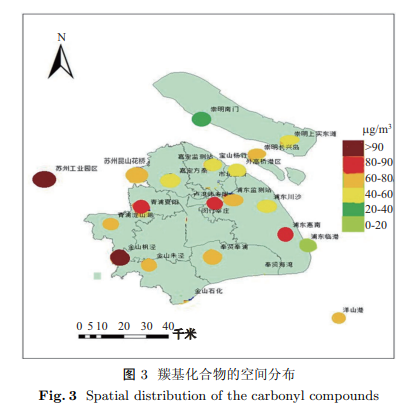
使用实验室自主研发的多通道含氧挥发性有机物 (oxygenated volatile organic compound, OVOC) 远程控制采样器, 于 2017 年 8 月 4---7 日 对上海地区 20 个监测站点在早高峰 (6:00---9:00) 时段同步采集大气中 20 种羰基化合物, 并利用 2, 4-二硝基苯肼 (dinitrophenyl- hydrazone, NDPH)/高效液相色谱 (high performance liquid chromatography, HPLC) 法进行分析. 研究结果表明: 上海及其周边地区夏季大气中总羰基化合物浓度水平为 14.34$\sim$ 106.15 $\mu $g/m$^{3}$, 并呈现西部高、东南低的空间分布特征; 各地区浓度水平有明显差异, 其中浦东临港、崇明各采样点浓度较低, 金山枫泾、苏州工业园区最高. 甲醛、 乙醛和丙酮是大气中最主要的羰基化合物, 三者共占羰基化合物总量的 68%. 甲醛、乙醛、丙醛之间具有较好的相关性, 苯甲醛、庚醛、 辛醛、壬醛、癸醛之间也存在一定的正相关性, 说明它们之间有着相似的来源. 羰基化合物臭氧生成潜势 (ozone formation potential, OFP) 为 68.01$\sim $326.83 g/m$^{3}$, 其中甲醛贡献最大, 乙醛次之, 二者占羰基化合物臭氧生成潜势总量的 92.93%.
陈丰, 段玉森, 冯艳丽, 路飞 . 上海地区 2017 年夏季大气中羰基化合物的空间分布特征[J]. 上海大学学报(自然科学版), 2021 , 27(1) : 86 -96 . DOI: 10.12066/j.issn.1007-2861.2060
A multi-channel oxygenated volatile organic compound (OVOC) remote control sampler developed in a laboratory and a ternary-mobile phase programme named DNPH- HPLC were used simultaneously to measure the concentration levels of 20 carbonyl compounds in the atmosphere in Shanghai from 4th to 7th August, 2017. The sampling time was 6:00---9:00 a.m. The results indicated that the total concentrations of carbonyls in the atmosphere of the Shanghai area varied from 14.34 to 106.15 $\mu $g/m3, characterised by higher levels in the west and lower levels in the southeast. The concentrations in each area were significantly different. The concentrations in Lingang and Chongming were relatively low, while those of Fengjing and Suzhou Industrial Park were the highest. This pattern was similar to the spatial distribution of VOCs detected in the same periodin the same region. Formaldehyde, acetaldehyde, and acetone were the main carbonyl compounds in the atmosphere, accounting for 68% of the total carbonyl compounds. Suitable correlations were observed among formaldehyde, acetaldehyde, and propionaldehyde. Benzaldehyde, heptanal, octanal, nonanal, and decanal were also correlated, indicating similar sources. The ozone formation potential (OFP) of carbonyl compounds varied from 68.01 to 326.83 $\mu $g/m3, with formaldehyde having the largest contribution and acetaldehyde the second largest. They accounted for 92.93% of the total OFP.
| [1] | Liggio J, Li S M, Mclaren R. Reactive uptake of glyoxal by particulate matter[J]. Journal of Geophysical Research Atmospheres, 2005,110:D10304. |
| [2] | Singh H B, Kanakidou M, Crutzen P J, et al. High concentrations and photochemical fate of oxygenated hydrocarbons in the global troposphere[J]. Nature, 1995,378(6552):50-54. |
| [3] | Hong L W, J Sheng A J, L Sheng R L, et al. Volatile organic compounds (VOCs) source profiles of on-road vehicle emissions in China [J]. Science of the Total Environment, 2017,607/608:253-261. |
| [4] | Possanzini M, Palo V D, Cecinato A. Sources and photodecomposition of formaldehyde and acetaldehyde in Rome ambient air[J]. Atmospheric Environment, 2002,36(19):3195-3201. |
| [5] | 陈曦, 李杏茹. 大气中挥发性含氧有机物研究进展[J]. 首都师范大学学报 (自然科学版), 2018,39(3):45-55. |
| [5] | Chen X, Li X R. Research of volatile oxygen-containing organic compounds in the atmosphere[J]. Journal of Capital Normal University: Natural Science, 2018,39(3):45-55. |
| [6] | Tanner R L, Meng Z. Seasonal variations in ambient atmospheric levels of formaldehyde and acetaldehyde[J]. Environmental Science & Technology, 1984,18(9):723-726. |
| [7] | Turpin B J, Andrews E, Saxena P. Measuring and simulating particulate organics in the atmosphere: problems and prospects[J]. Atmospheric Environment, 2000,34(18):2983-3013. |
| [8] | 黄娟, 冯艳丽, 熊斌, 等. 上海市大气羰基化合物水平研究[J]. 环境科学, 2009,30(9):2701-2706. |
| [8] | Huang J, Feng Y L, Xiong B, et al. Sesearch on the atmospheric carbonyl compound level in Shanghai[J]. Environmental Science, 2009,30(9):2701-2706. |
| [9] | Ho K F, Ho S S H, Huang R J, et al. Spatiotemporal distribution of carbonyl compounds in China[J]. Environmental Pollution, 2015,197:316-324. |
| [10] | Chen W T, Shao M, Wang M, et al. Variation of ambient carbonyl levels in urban Beijing between 2005 and 2012[J]. Atmospheric Environment, 2016,129:105-113. |
| [11] | Rao Z H, Chen Z M, Liang H, et al. Carbonyl compounds over urban Beijing: concentrations on haze and non-haze days and effects on radical chemistry[J]. Atmospheric Environment, 2016,124:207-216. |
| [12] | 王琴, 邵敏, 魏强, 等. 北京及周边地区大气羰基化合物的时空分布特征初探[J]. 环境科学, 2011,32(12):3522-3530. |
| [12] | Wang Q, Shao M, Wei Q, et al. Exploration about spatial distribution characteristics of atmospheric carbonyl compounds in Beijing and its surrounding areas[J]. Environmental Science, 2011,32(12):3522-3530. |
| [13] | 冯艳丽, 陈颖军, 文晟, 等. 广州大气中羰基化合物特征[J]. 环境科学与技术, 2007,30(2):51-54. |
| [13] | Feng Y L, Chen Y J, Wen S, et al. Characteristics of carbonyl compounds in the atmosphere in Guangzhou[J]. Environmental Science and Technology, 2007,30(2):51-54. |
| [14] | 周雪明, 谭吉华, 项萍, 等. 佛山市冬夏季羰基化合物污染特征[J]. 中国环境科学, 2017,37(3):844-850. |
| [14] | Zhou M X, Tan J H, Xiang P, et al. Characteristics of carbonyl compounds pollution in winter and summer in Foshan City[J]. Chinese Environmental Science, 2017,37(3):844-850. |
| [15] | Ho K F, Lee S C, Louie P K K, et al. Seasonal variation of carbonyl compound concentrations in urban area of Hong Kong[J]. Atmospheric Environment, 2002,36(8):1259-1265. |
| [16] | Possanzini M, Palo V D, Brancaleoni E, et al. A train of carbon and DNPH-coated cartridges for the determination of carbonyls from C1 to C12 in air and emission samples[J]. Atmospheric Environment, 2000,34(29):5311-5318. |
| [17] | Zhang J, Lioy P J, He Q. Characteristics of aldehydes: concentrations, sources and exposures for indoor and outdoor residential microenvironments[J]. Environmental Science & Technology, 1994,28(1):146-152. |
| [18] | 徐竹, 庞小兵, 牟玉静. 北京市大气和降雨中醛酮化合物的污染研究[J]. 环境科学学报, 2006,26(12):1948-1954. |
| [18] | Xu Z, Pang X B, Mu Y J. Research on the contamination of aldehydes and ketones in atmosphere and rainfall in Beijing[J]. Journal of Environmental Science, 2006,26(12):1948-1954. |
| [19] | Carter W P L. Computer modeling of environmental chamber measurements of maximum incremental reactivities of volatile organic compounds[J]. Atmospheric Environment, 1995,29(18):2513-2527. |
| [20] | Anderson L G, Lanning J A, Barrell R, et al. Sources and sinks of formaldehyde and acetaldehyde: an analysis of Denver's ambient concentration data[J]. Atmospheric Environment, 1996,30(12):2113-2123. |
| [21] | 张玉洁, 庞小兵, 牟玉静. 北京市植物排放的异戊二烯对大气中甲醛的贡献[J]. 环境科学, 2009,30(4):976-981. |
| [21] | Zhang Y J, Pang X B, Mu Y J. The contribution of isoprene emission from Beijing plants to formaldehyde in the atmosphere[J]. Environmental science, 2009,30(4):976-981. |
| [22] | 黄娟, 冯艳丽, 王新明, 等. 浙江嘉兴农场大气羰基化合物水平及来源[J]. 中国环境科学, 2009,29(8):795-800. |
| [22] | Huang J, Feng Y L, Wang X M, et al. Levels and sources of atmospheric carbonyl compounds in Jiaxing farm, Zhejiang Province[J]. Chinese Environmental Science, 2009,29(8):795-800. |
| [23] | Weng M L, Zhu L Z, Yang K, et al. Levels, sources, and health risks of carbonyls in residential indoor air in Hangzhou, China[J]. Environmental Monitoring & Assessment, 2010,163(1/2/3/4):573-581. |
| [24] | 周咪, 蔡慧华, 黄锐雄, 等. 典型工业园污染源羰基化合物排放特征研究[J]. 中国环境监测, 2018,34(1):69-77. |
| [24] | Zhou M, Cai J H, Huang R X, et al. Research on emission characteristics of carbonyl compounds from pollution sources in typical industrial parks[J]. Chinese Environmental Monitoring, 2018,34(1):69-77. |
| [25] | Wei W, Wang S X, Hao J M, et al. Projection of anthropogenic volatile organic compounds (VOCs) emissions in China for the Period 2010---2020[J]. Atmospheric Environment, 2011,45(38):6863-6871. |
| [26] | 莫梓伟, 邵敏, 陆思华. 中国挥发性有机物 (VOCs) 排放源成分谱研究进展[J]. 环境科学学报, 2014,34(9):2179-2189. |
| [26] | Mo Z W, Shao M, Lu S H. Research progress of compositional profiles of volatile organic compounds (VOCs) in China[J]. Journal of Environmental Science, 2014,34(9):2179-2189. |
| [27] | Kumar A, Singh D, Kumar K, et al. Distribution of VOCs in urban and rural atmospheres of subtropical India: temporal variation, source attribution, ratios, OFP and risk assessment[J]. Science of the Total Environment, 2017,613/614:492-501. |
| [28] | Yan Y L, Peng L, Li R M, et al. Concentration, ozone formation potential and source analysis of volatile organic compounds (VOCs) in a thermal power station centralized area: a study in Shuozhou, China[J]. Environmental Pollution, 2017,223:295-304. |
| [29] | Duan J C, Tan J H, Yang L, et al. Concentration, sources and ozone formation potential of volatile organic compounds (VOCs) during ozone episode in Beijing[J]. Atmospheric Research, 2008,88(1):25-35. |
/
| 〈 |
|
〉 |
