
收稿日期: 2018-05-13
网络出版日期: 2019-07-05
基金资助
国家自然科学基金资助项目(11374228)
Effects of electron beam irradiation on microstructures and thermoelectric power factors of β-Zn4Sb3 thin films
Received date: 2018-05-13
Online published: 2019-07-05
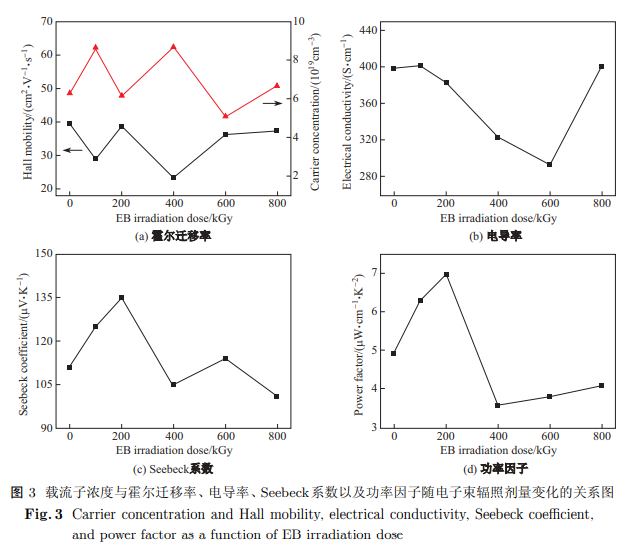
通过射频磁控溅射制备 Zn-Sb 预沉积薄膜, 随后依次进行 0~800 kGy 不同剂量的电子束辐照处理和常规热退火, 获得 β-Zn4Sb3 热电薄膜. 利用 X 射线衍射仪 (X-raydiffraction, XRD) 和场发射扫描电子显微镜 (field emission scanningelectron microscopy, FESEM) 分析表征了薄膜的微结构和表面形貌,利用 Hall 效应和 Seebeck 效应检测了薄膜的电输运和热电性能.研究结果表明, 所有样品均表现出 p 型导电.经电子束辐照处理的薄膜样品, 其物相组成没有发生变化,平均晶粒尺寸变化不大, 但薄膜表面的致密度有所提高,且晶粒生长表现出一定的 (223) 晶面取向性生长.当电子束辐照剂量为 200 kGy 时,由于在电导率降幅很小的同时 Seebeck 系数得到了有效的提高,故样品的功率因子可达 6.90 μW/(cm·K2),比未进行电子束辐照处理的样品提高了 41.7%.
关键词: 热电; β-Zn4Sb3薄膜; 磁控溅射; 电子束辐照; 功率因子
高鹏飞, 欧正海, 秦娟, 史伟民, 王林军 . 电子束辐照对 β-Zn4Sb3 薄膜微结构和热电功率因子的影响[J]. 上海大学学报(自然科学版), 2020 , 26(6) : 937 -944 . DOI: 10.12066/j.issn.1007-2861.2168
In this study, β-Zn4Sb3 thermoelectric thin films were fabricated by radio-frequency magnetron sputtering with subsequent electron beam (EB) irradiation with different doses of 0~800 kGy and thermal annealing. The microstructures and surface morphologies of the films were characterised by X-ray diffraction (XRD) and field emission scanning electron microscopy (FESEM). The electrical transport and thermoelectric properties of the films were analysed by Hall effect and Seebeck effect measurements. All samples exhibited p-type conduction characteristics. The phase compositions and average grain sizes of the samples subjected to EB irradiation slightly changed, the film surface was more densely compacted, and the grain growth exhibited a preferred orientation along the (223) crystallographic plane. When the EB irradiation dose was 200 kGy, the power factor of the sample reached 6.90 μW/(cm·K2) as the Seebeck coefficient was effectively increased while the conductivity was slightly reduced. This power factor was increased by 41.7% compared to that of the sample without EB irradiation.
| [1] | Altenkirch E. Elektrothermische K?lteerzeugung und reversible elektrische Heizung[J]. Physikalische Zeitschrift, 1911,12:920-924. |
| [2] | Hu L, Zhu T, Liu X, et al. Point defect engineering of high-performance Bismuth-Telluride-based thermoelectric materials[J]. Advanced Functional Materials, 2014,24(33):5211-5218. |
| [3] | Zhai R S, Wu Y H, Zhu T J, et al. Thermoelectric performance of p-type zone-melted Se-doped Bi$_{0.5}$Sb$_{1.5}$Te$_{3}$ alloys[J]. Rare Metals, 2018,37(4):308-315. |
| [4] | 张骐昊, 徐磊磊, 王连军, et al. Se掺杂量对n型Bi$_{2}$Te$_{3-x}$Se$_{x}$微结构及热电性能的影响[J]. 无机材料学报, 2014,29(11):1139-1144. |
| [5] | Pei Y, Lalonde A D, Wang H, et al. Low effective mass leading to high thermoelectric performance[J]. Energy and Environmental Science, 2012,5(7):7963-7969. |
| [6] | Qin B C, Xiao Y, Zhou Y M, et al. Thermoelectric transport properties of Pb-Sn-Te-Sesystem[J]. Rare Metals, 2018,37(4):343-350. |
| [7] | Slack G A, Hussain M A. The maximum possible conversion efficiency of silicon-germanium thermoelectric generators[J]. Journal of Applied Physics, 1991,70(5):2694-2718. |
| [8] | Vining C B, Laskow W, Hanson J O, et al. Thermoelectric properties of pressure-sintered Si$_{0.8}$Ge$_{0.2}$ thermoelectric alloys[J]. Journal of Applied Physics, 1991,69(8):4333-4340. |
| [9] | Mayer H, Mikhail I, Schubert K. über einige phasen der Mischungen ZnSbN undCdSbN[J]. Journal of the Less Common Metals, 1978,59(1):43-52. |
| [10] | Tapiero M, Tarabichi S, Gies J, et al. Preparation and characterization of Zn$_{4}$Sb$_{4}$[J]. Solar Energy Materials, 1985,12(4):257-274. |
| [11] | Yang J, Liu G, Shi Z, et al. An insight into $\beta $-Zn$_{4}$Sb$_{3}$ from its crystal structure, thermoelectric performance, thermal stability and graded material[J]. Materials Today Energy, 2017,3:72-83. |
| [12] | Meldrum A, Boatner L, Ewing R. Electron-irradiation-induced nucleation and growth in amorphous LaPO$_{4}$, ScPO$_{4}$, and zircon[J]. Journal of Materials Research, 1997,12(7):1816-1827. |
| [13] | Zhang T, Song Z, Sun M, et al. Investigation of electron beam induced phase change in Si$_{2}$Sb$_{2}$Te$_{5}$ material[J]. Applied Physics A, 2008,90(3):451-455. |
| [14] | Qin W, Szpunar J, Umakoshi Y. Electron or ion irradiation-induced phase-change mechanism between amorphous and crystalline state[J]. Acta Materialia, 2011,59(5):2221-2228. |
| [15] | Takashiri M, Imai K, Uyama M, et al. Effects of homogeneous irradiation of electron beam on crystal growth and thermoelectric properties of nanocrystalline bismuth selenium telluride thin films[J]. Journal of Alloys and Compounds, 2014,612:98-102. |
| [16] | Takashiri M, Hamada J. Bismuth antimony telluride thin films with unique crystal orientation by two-step method[J]. Journal of Alloys and Compounds, 2016,683:276-281. |
| [17] | Zeng Z, Yang P, Hu Z. Temperature and size effects on electrical properties and thermoelectric power of Bismuth Telluride thin films deposited by co-sputtering[J]. Applied Surface Science, 2013,268:472-476. |
| [18] | Swapna R, Kumar M S. Growth and characterization of molybdenum doped ZnO thin films by spray pyrolysis[J]. Journal of physics and chemistry of solids, 2013,74(3):418-425. |
| [19] | Medjani F, Sanjines R, Allidi G, et al. Effect of substrate temperature and bias voltage on the crystallite orientation in RF magnetron sputtered AlN thin films[J]. Thin Solid Films, 2006,515(1):260-265. |
| [20] | Ba L, Qin Y, Wu Z. Electron beam induced crystallization of a Ge-Au amorphous film[J]. Journal of Applied Physics, 1996,80(11):6170-6174. |
| [21] | Das V D, Lakshmi P J. Electron-beam-induced `explosive' crystallization of amorphous Se$_{80}$Te$_{20}$ alloy thin films and oriented growth of crystallites[J]. Physical Review B, 1988,37(2):720. |
| [22] | Diniz A, Kiely C. Crystallisation of indium-tin-oxide (ITO) thin films[J]. Renewable Energy, 2004,29(13):2037-2051. |
| [23] | Chen H, Li K, Yang M, et al. Effect of electron beam irradiation in TEM on the microstructure and composition of nanoprecipitates in Al-Mg-Si alloys[J]. Micron, 2019,116:116-123. |
| [24] | Zhou X, Wang G, Zhang L, et al. Enhanced thermoelectric properties of Ba-filled skutterudites by grain size reduction and Ag nanoparticle inclusion[J]. Journal of Materials Chemistry, 2012,22(7):2958-2964. |
| [25] | Hu L, Wu H, Zhu T, et al. Tuning multiscale microstructures to enhance thermoelectric performance of n-type Bismuth-Telluride-based solid solutions[J]. Advanced Energy Materials, 2015,5(17):1500411. |
/
| 〈 |
|
〉 |
