
收稿日期: 2018-09-12
网络出版日期: 2018-09-21
基金资助
国家自然科学基金青年科学基金资助项目(11404206)
Two-dimensional material band gap prediction based on machine learning method
Received date: 2018-09-12
Online published: 2018-09-21
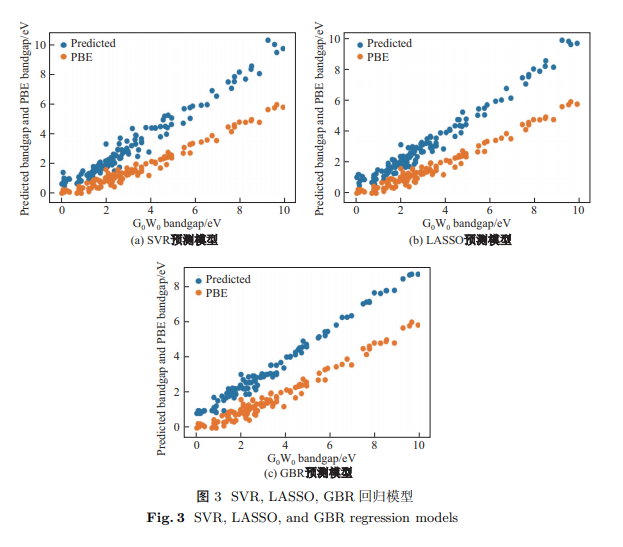
利用密度泛函理论与机器学习相结合的方法, 对二维金属化合物的带隙进行研究, 得到比传统理论计算成本更低且更有效的带隙预测方法. 以广义梯度近似(general gradient approximation, GGA)-Perdew-Burke-Ernzerhof (PBE) (GGA-PBE) 和 G0W0 的带隙计算结果为参考, 考察了化学通式为 MX2 的二维材料数据集. 利用套索回归, 即最小绝对值收敛和选择算子(least absolute shrinkage and selection operator, LASSO)、支持向量回归(support vector regression, SVR)和梯度树提升回归(gradient boosting regression, GBR)等机器学习方法建立带隙的预测模型. 测试结果表明, 对于大多数二维材料, 基于线性核函数的 SVR 与 LASSO 模型的预测性能相对较好, 训练模型的平均绝对误差为 0.34 eV, 测试集误差为 0.5 eV. 这说明对于二维材料带隙采取的特征参数集具有一定的完备性和合理性, 对新材料带隙的初步预测有一定的参考价值.
游洋 , 杜婉 , 李惟驹 , 陈竞哲 . 基于机器学习方法的二维材料带隙预测[J]. 上海大学学报(自然科学版), 2020 , 26(5) : 824 -833 . DOI: 10.12066/j.issn.1007-2861.2089
Machine learning (ML) algorithm and the traditional density functional theory (DFT) are combined to study the band gap of two-dimensional metal compounds, and as a result, a simple and effective model which is more cost-effective than the traditional quantum calculation method is established. Results of general gradient approximation-Perdew-Burke-Ernzerhof (GGA-PBE) and G0W0 are taken as reference and a two-dimensional material data set with chemical formula MX2 is investigated. Least absolute shrinkage and selection operator (LASSO), support vector machine regression (SVR) and gradient boosting regressor (GBR) and other machine learning methods are used to build a band gap prediction model. Among these models, it is found that the SVR model based on linear kernel function and LASSO model both can give a good prediction result, the mean absolute error (MAE) of training model is 0.34 eV and MAE of testing set is 0.5 eV. Thus, for the prediction of two-dimensional material band gap, the feature parameter set adopted by us has a certain completeness and rationality, which has a certain reference value for the preliminary prediction for the band gap of new materials.
Key words: two-dimensional materials; first principles; machine learning; band gap
| [1] | Chhowalla M, Shin H S, Eda G, et al. The chemistry of two-dimensional layered transition metal dichalcogenide nanosheets[J]. Nature Chemistry, 2013,5(4):263-275. |
| [2] | Miro P, Audiffred M, Heine T. An atlas of two-dimensional materials[J]. Chemical Society Reviews, 2014,43(18):6537-6554. |
| [3] | Liu G B, Xiao D, Yao Y, et al. Electronic structures and theoretical modelling of two-dimensional group-VIB transition metal dichalcogenides[J]. Chemical Society Reviews, 2015,44(9):2643-2663. |
| [4] | Segall M, Lindan P J, Probert M A, et al. First-principles simulation: ideas, illustrations and the CASTEP code[J]. Journal of Physics: Condensed Matter, 2002,14(11):2717. |
| [5] | Bickelhaupt F M, Baerends E J. Kohn-Sham density functional theory: predicting and understanding chemistry[J]. Reviews in Computational Chemistry, 2007. DOI: 10.1002/9780470125922.ch1 |
| [6] | Fuchs F, Furthmller J, Bechstedt F, et al. Quasiparticle band structure based on a generalized Kohn-Sham scheme[J]. Physical Review B, 2007,76(11):115109. |
| [7] | Landis D D, Hummelsh J J S, Nestorov S, et al. The computational materials repository[J]. Computing in Science & Engineering, 2012,14(6):51-57. |
| [8] | Tibshirani R. Regression shrinkage and selection via the lasso[J]. Journal of the Royal Statistical Society Series B, 1996,58(1):267-288. |
| [9] | Breiman L. Better subset regression using the nonnegative garrote[J]. Technometrics, 1995,37(4):373-384. |
| [10] | Cortes C, Vapnik V. Support-vector networks[J]. Machine Learning, 1995,20(3):273-297. |
| [11] | Smola A J, Schlkopf B. A tutorial on support vector regression[J]. Statistics and Computing, 2004,14(3):199-222. |
| [12] | Ben-Hur A, Horn D, Siegelmann H T, et al. Support vector clustering[J]. Journal of Machine Learning Research, 2001,2:125-137. |
| [13] | Friedman J H. Stochastic gradient boosting[J]. Computational Statistics & Data Analysis, 2002,38(4):367-378. |
| [14] | Friedman J H. Greedy function approximation: a gradient boosting machine[J]. Annals of Statistics, 2001,29(5):1189-1232. |
| [15] | Samuel A L. Some studies in machine learning using the game of checkers[J]. IBM Journal of Research and Development, 1959,3(3):210-229. |
| [16] | Wernick M N, Yang Y, Brankov J G, et al. Machine learning in medical imaging[J]. IEEE Signal Processing Magazine, 2010,27(4):25-38. |
| [17] | Armstrong J. Illusions in regression analysis[J]. International Journal of Forecasting, 2012,28(3):689-698. |
| [18] | Hofmann T, Schlkopf B, Smola A J. Kernel methods in machine learning[J]. Annals of Statistics, 2008,36(3):1171-1220. |
| [19] | Suykens J A, De Brabanter J, Lukas L, et al. Weighted least squares support vector machines: robustness and sparse approximation[J]. Neurocomputing, 2002,48:85-105. |
| [20] | Wilson J A, Yoffe A D. The transition metal dichalcogenides discussion and interpretation of the observed optical, electrical and structural properties[J]. Advances in Physics, 1969,18(73):193-335. |
| [21] | Kohavi R. A study of cross-validation and bootstrap for accuracy estimation and model selection[C]// IJCAI. 1995: 1137-1145. |
/
| 〈 |
|
〉 |
