
Positive effect of cognitive reappraisal on low Theta electroencephalogram activity
Received date: 2018-07-21
Online published: 2018-08-02
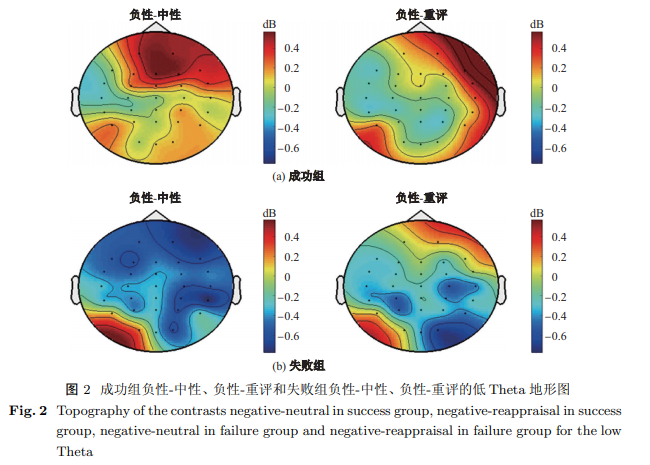
认知重评是情绪调控的重要策略之一, 然而并不是每一次策略的执行都会成功, 这种现象背后的生理机制尚缺乏研究. 通过分析比较成功完成认知重评任务与未成功完成任务的两组人的头皮脑电, 探索这种差异背后的电生理机制. 招募 29 名健康志愿者完成认知重评任务、观看负性图片、 观看中性图片三种任务, 并同时采集头皮脑电. 实验后根据被试负性刺激的效价和唤醒度评分结果, 对重评成功和失败进行了分配入组, 其中成功组 15 人, 失败组 14 人. 进一步分析脑电事件相关谱扰动 (event-related spectral perturbation, ERSP)显示: 当完成认知重评任务时, 在刺激后 300~1 200 ms 内, 成功组的前额低 Theta 频段 (4.0~6.5 Hz)活动显著高于失败组; 在刺激后 1 200~2 700 ms 内, 仅在成功组发现了前额偏侧化现象, 其左侧前额 ERSP 显著高于右侧前额, 且在左侧前额区发现 组间差异, 成功组 ERSP 显著高于失败组; 最后,在认知重评任务下, 刺激后 300~1 200 ms 内, 无论是成功组还是失败组, 前额左侧 ERSP 均显著高于前额右侧 ERSP. 综上, 是否成功完成认知重评 任务在脑电频谱特性上是可以区分的. 前额低 Theta 频段的活跃程度可以在一定程度上反映一个人认知重评能力的高低, 所得研究结果为评价个体的情绪调控能力提供了一个潜在的客观指标.
赵敏捷 , 李颖洁 . 成功完成认知重评任务增强低 Theta 脑电活动[J]. 上海大学学报(自然科学版), 2020 , 26(5) : 735 -746 . DOI: 10.12066/j.issn.1007-2861.2084
Cognitive reappraisal is one of the important strategies for emotional regulation. However, not every implementation of the strategy will succeed. The research on the physiological mechanism behind this phenomenon is still lacking. By analyzing the neural activity of a group who has successfully completed the cognitive reappraisal task and another group failing to complete the task, this study tries to explore the related electrophysiological mechanism. In conducting the research, 29 healthy subjects have been recruited, and they have been asked to complete the task of cognitive reappraisal, watching negative emotional images and neutral images, while their scalp electroencephalogram (EEG)s are collected simultaneously. According to the ratings of valence and arousal to the reappraisal of negative stimuli, the participants have been divided into two groups with cognitive reappraisal of success (15 subjects) and failure (14 subjects) respectively. The event-related spectral perturbation (ERSP) analysis shows that, under the condition of cognitive reappraisal, the low Theta (4.0~6.5 Hz) activity of the successful group is significantly higher than the failure group within 300 to 1 200 ms after the stimulus onset. Within 1 200 to 2 700 ms after the stimulus onset, the frontal lateralization is found only in the successful group, showing that the left frontal ERSP is significantly higher than the right frontal ERSP. Moreover, the left frontal ERSP in the successful group is significantly higher than in the failure group. In addition, in the task of cognitive reappraisal; the left frontal ERSP is significantly higher than the right frontal in both groups within 300 to 1 200 ms after the stimulus onset. In summary, whether or not cognitive reappraisal can be successfully completed is distinguishable in the EEG spectrum. To some extent, the activity of frontal low Theta can reflect the level of a person's cognitive reappraisal ability, which provides a potential objective indicator for evaluating individual's emotion regulation ability.
Key words: emotion regulation; cognitive reappraisal; low Theta; lateralization
| [1] | Gross J J. Emotion regulation: affective, cognitive, and social consequences[J]. Psychophysiology, 2002,39(3):281-291. |
| [2] | Lieberman M D, Inagaki T K, Tabibnia G, et al. Subjective responses to emotional stimuli during labeling, reappraisal, and distraction[J]. Emotion, 2011,11(3):468-480. |
| [3] | Zilverstand A, Parvaz M A, Goldstein R Z. Neuroimaging cognitive reappraisal in clinical populations to define neural targets for enhancing emotion regulation: a systematic review[J]. NeuroImage, 2017,151:105-116. |
| [4] | Wager T D, Davidson M L, Hughes B L, et al. Prefrontal-subcortical pathways mediating successful emotion regulation[J]. Neuron, 2008,59(6):1037-1050. |
| [5] | Johnstone T, Van Reekum C M, Urry H L, et al. Failure to regulate: counterproductive recruitment of top-down prefrontal-subcortical circuitry in major depression[J]. The Journal of Neuroscience, 2007,27(33):8877-8884. |
| [6] | Ertl M, Hildebrandt M, Ourina K, et al. Emotion regulation by cognitive reappraisal: the role of frontal theta oscillations[J]. NeuroImage, 2013,81:412-421. |
| [7] | Wei L, Zhao M, Yang X, et al. Theta oscillations during cognitive reappraisal of sad and fearful stimuli[C]// International IEEE/EMBS Conference on Neural Engineering. 2017: 560-563. |
| [8] | Mauss I B, Cook C L, Cheng J Y J, et al. Individual differences in cognitive reappraisal: experiential and physiological responses to an anger provocation[J]. International Journal of Psychophysiology, 2007,66(2):116-124. |
| [9] | Zhang W, Li X, Liu X, et al. Distraction reduces theta synchronization in emotion regulation during adolescence[J]. Neuroscience Letters, 2013,550:81-86. |
| [10] | Dillon D, Pizzagalli D. Evidence of successful modulation of brain activation and subjective experience during reappraisal of negative emotion in unmedicated depression[J]. Psychiatry Research: Neuroimaging, 2013,212(2):99-107. |
| [11] | Kalisch R. The functional neuroanatomy of reappraisal: time matters[J]. Neuroscience and Biobehavioral Reviews, 2009,33(8):1215-1226. |
| [12] | Phan K L, Fitzgerald D A, Nathan P J, et al. Neural substrates for voluntary suppression of negative affect: a functional magnetic resonance imaging study[J]. Biological Psychiatry, 2005,57(3):210-219. |
| [13] | Ochsner K N, Silvers J A, Buhle J T. Functional imaging studies of emotion regulation: a synthetic review and evolving model of the cognitive control of emotion[J]. Annals of the New York Academy of Sciences, 2012,1251:E1-E24. |
| [14] | Beauregard M, Paquette V, Lévesque J. Dysfunction in the neural circuitry of emotional self-regulation in major depressive disorder[J]. Neuroreport, 2006,17(8):843-846. |
| [15] | Townsend J, Torrisi S, Lieberman M D, et al. Frontal-amygdala connectivity alterations during emotion downregulation in bipolarⅠ disorder[J]. Biological Psychiatry, 2013,73(2):127-135. |
| [16] | Weber H, De Assuncao V L, Martin C, et al. Reappraisal inventiveness: the ability to create different reappraisals of critical situations[J]. Cognition and Emotion, 2014,28(2):345-360. |
| [17] | Papousek I, Weiss E M, Perchtold C M, et al. The capacity for generating cognitive reappraisals is reflected in asymmetric activation of frontal brain regions[J]. Brain Imaging and Behavior, 2017,11(2):577-590. |
| [18] | Thiruchselvam R, Blechert J, Sheppes G, et al. The temporal dynamics of emotion regulation: an EEG study of distraction and reappraisal[J]. Biological Psychology, 2011,87(1):84-92. |
| [19] | Yuan L, Zhou R, Hu S. Cognitive reappraisal of facial expressions: electrophysiological evidence of social anxiety[J]. Neuroscience Letters, 2014,577:45-50. |
| [20] | Clochon P, Fontbonne J, Lebrun N, et al. A new method for quantifying EEG event-related desynchronization: amplitude envelope analysis[J]. Electroencephalography and Clinical Neurophysiology, 1996,98(2):126-129. |
| [21] | Delorme A, Makeig S. EEGLAB: an open source toolbox for analysis of single-trial EEG dynamics including independent component analysis[J]. Journal of Neuroscience Methods, 2004,134(1):9-21. |
| [22] | Mitra P P, Pesaran B. Analysis of dynamic brain imaging data[J]. Biophysical Journal, 1999,76(2):691-708. |
| [23] | Van Quyen M L, Foucher J, Lachaux J, et al. Comparison of Hilbert transform and wavelet methods for the analysis of neuronal synchrony[J]. Journal of Neuroscience Methods, 2001,111(2):83-98. |
| [24] | Bruns A. Fourier-, Hilbert- and wavelet-based signal analysis: are they really different approaches?[J]. Journal of Neuroscience Methods, 2004,137(2):321-332. |
| [25] | 赵晶晶, 牟书, 舒华, 等. 基于Morlet 小波变换的 EEG 时频分析[J]. 中国医学物理学杂志, 2006,23(1):56-59. |
| [26] | Grandchamp R, Delorme A. Single-trial normalization for event-related spectral decomposition reduces sensitivity to noisy trials[J]. Frontiers in Psychology, 2011. DOI: 10.3389/fpsyg.2011.00236. |
| [27] | Cavanagh J F, Frank M J. Frontal theta as a mechanism for cognitive control[J]. Trends in Cognitive Sciences, 2014,18(8):414-421. |
| [28] | Aftanas L I, Pavlov S V, Reva N V, et al. Trait anxiety impact on the EEG theta band power changes during appraisal of threatening and pleasant visual stimuli[J]. International Journal of Psychophysiology, 2003,50(3):205-212. |
| [29] | Aftanas L I, Varlamov A A, Pavlov S V, et al. Affective picture processing: event-related synchronization within individually defined human theta band is modulated by valence dimension[J]. Neuroscience Letters, 2001,303(2):115-118. |
| [30] | Knyazev G G Slobodskoj-Plusnin J Y, Bocharov A V. Gender differences in implicit and explicit processing of emotional facial expressions as revealed by event-related theta synchronization[J]. Emotion, 2010,10(5):678-687. |
| [31] | Knyazev G G, Slobodskoj-Plusnin J Y, Bocharov A V. Event-related delta and theta synchronization during explicit and implicit emotion processing[J]. Neuroscience, 2009,164(4):1588-1600. |
| [32] | Narayanan V, Heiming R S, Jansen F, et al. Social defeat: impact on fear extinction and amygdala-prefrontal cortical theta synchrony in 5-HTT deficient mice[J]. PLoS One, 2011,6(7):e22600. |
| [33] | Buhle J T, Silvers J A, Wager T D, et al. Cognitive reappraisal of emotion: a meta-analysis of human neuroimaging studies[J]. Cerebral Cortex, 2014,24(11):2981-2990. |
| [34] | Diekhof E K, Geier K, Falkai P, et al. Fear is only as deep as the mind allows: a coordinate-based meta-analysis of neuroimaging studies on the regulation of negative affect[J]. NeuroImage, 2011,58(1):275-285. |
| [35] | Lesting J, Narayanan R T, Kluge C, et al. Patterns of coupled theta activity in amygdala-hippocampal-prefrontal cortical circuits during fear extinction[J]. PLoS One, 2011,6(6):e21714. |
| [36] | Delgado M R, Nearing K I, Ledoux J E, et al. Neural circuitry underlying the regulation of conditioned fear and its relation to extinction[J]. Neuron, 2008,59(5):829-838. |
| [37] | Dorfel D, Lamke J, Hummel F, et al. Common and differential neural networks of emotion regulation by detachment, reinterpretation, distraction, and expressive suppression: a comparative fMRI investigation[J]. NeuroImage, 2014,101:298-309. |
/
| 〈 |
|
〉 |
