
收稿日期: 2018-05-11
网络出版日期: 2018-08-08
基金资助
生态纺织教育部重点实验室开放课题
Mixed-metal oxide derived from bimetal-organic frameworks for performance lithium-ion batteries
Received date: 2018-05-11
Online published: 2018-08-08
张燕锋 , 蔡昌 , 谈馨怡 , 孙炜伟 . 金属有机骨架衍生双金属氧化物的锂离性能[J]. 上海大学学报(自然科学版), 2021 , 27(1) : 125 -132 . DOI: 10.12066/j.issn.1007-2861.2072
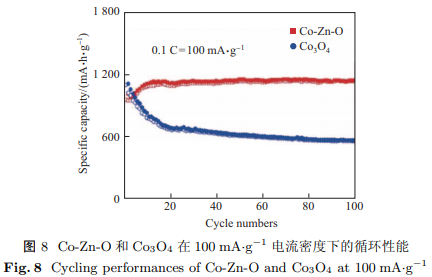
Co/Zn bimetal organic framework precursor (Co/Zn-MOF-74) has been obtained by using the one-step facile microwave-assisted solvothermal method. By calcining the Co/Zn-MOF-74 at 500 ${^\circ}$C under air, the mesoporous mixed-metallic Co-Zn-O microrod can be obtained. When applied as the anode materials for lithium-ion batteries, the Co-Zn-O electrode exhibits good electrochemical properties (reversible capacity of 1 137 mA$\cdot$h$\cdot$g-1 after 100 cycles), which could be attributed to its mesoporous nanostructure along with the synergistic effects between two different metal species.
| [1] | 杨遇春. 二次锂电池进展[J]. 电池, 1993,23(5):230-233. |
| [1] | Yang Y C. Recent progress in lithiumion rechargeable battery[J]. Battery, 1993,23(5):230-233. |
| [2] | Bruno S. Recent advance in lithium ion battery materials[J]. Electrochem Acta, 2000,45(15):2461-2466. |
| [3] | Shim H W, Jin Y H, Seo S D, et al. Highly reversible lithium storage in bacillus subtilis-directed porous Co$_{3}$O$_{4}$ nanostructures[J]. ACS Nano, 2011,5(1):443-449. |
| [4] | Kong S F, Dai R L, Li H, et al. Microwave hydrothermal synjournal of Ni-based metal-organic frameworks and their derived yolk-shell NiO for Li-ion storage an and supported ammonia borane for hydrogen desorption[J]. ACS Sustainable Chem Eng, 2015,3(8):1830-1838. |
| [5] | Sasidharan M, Gunawardhana N, Senthil C, et al. Micelle templated NiO hollow nanospheres as anode materials in lithium ion batteries[J]. J Mater Chem A, 2014,2:7337-7344. |
| [6] | Idota Y, Kubota T, Matsufuji A, et al. Tin-based amorphous oxide: a high-capacity lithium-ion-storage material[J]. Science, 1997,276(5317):1395-1397. |
| [7] | Brousse T, Retoux R, Herterich U, et al. Thin-film crystalline SnO$_{2}$-lithium electrodes[J]. J Electrochem Soc, 1998,29(16):1-4. |
| [8] | Liu H, Wang G. An investigation of the morphology effect in Fe$_{2}$O$_{3}$ anodes for lithium ion batteries[J]. J Mater Chem A, 2014,2:9955-9959. |
| [9] | Cheng M Y, Ye Y S, Chiu T M, et al. Size effect of nickel oxide for lithium ion battery anode[J]. J Power Sources, 2014,253(5):27-34. |
| [10] | Wu F D, Wang Y. Self-assembled echinus-like nanostructures of mesoporous CoO nanorod$@$CNT for lithium-ion batteries[J]. J Mater Chem, 2011,21(18):6636-6641. |
| [11] | Jiang J, Li Y, Liu J, et al. Recent advances in metal oxide-based electrode architecture design for electrochemical energy storage[J]. Adv Mater, 2012,24(38):5166-5180. |
| [12] | Poizot P, Laruelle S, Grugeon S, et al. Nano-sized transition-metal oxides as negative-electrode materials for lithium-ion batteries[J]. Nature, 2001,407:496-499. |
| [13] | Wu H, Xu M, Wu H, et al. Aligned NiO nanoflake arrays grown on copper as high capacity lithium-ion battery anodes[J]. J Mater Chem, 2012,22(37):19821-19825. |
| [14] | Lei D, Zhang M, Qu B, et al. $\alpha $-Fe$_{2}$O$_{3}$ Nanowall arrays: hydrothermal preparation, growth mechanism and excellent rate performances for lithium ion batteries[J]. Nanoscale, 2012,4(11):3422-3426. |
| [15] | Lu L Q, Wang Y. Sheet-like and fusiform CuO nanostructures grown on graphene by rapid microwave heating for high Li-ion storage capacities[J]. J Mater Chem, 2011,21(44):17916-17921. |
| [16] | Wu R B, Qian X K, Zhou K, et al. Porous spinel Zn$_{x}$Co$_{3-x}$O$_{4}$ hollow polyhedra templated for high-rate lithium-ion batteries[J]. ACS Nano, 2014,8(6):6297-6303. |
| [17] | Shao J, Wan Z M, Liu H M, et al. Metal organic frameworks-derived Co$_{3}$O$_{4}$ hollow dodecahedrons with controllable interiors as outstanding anodes for Li storage[J]. J Mater Chem A, 2014,2:12194-12200. |
| [18] | Zou Y, Wang Y. NiO nanosheets grown on graphene nanosheets as superior anode materials for Li-ion batteries[J]. Nanoscale, 2011,3(6):2615-2620. |
| [19] | Peng C X, Chen B D, Qin Y, et al. Facile ultrasonic synjournal of CoO quantum dot/graphene nanosheet composites with high lithium storage capacity[J]. ACS Nano, 2012,6(2):1074-1081. |
| [20] | Wang H L, Cui L F, Yang Y, et al. Mn$_{3}$O$_{4}$-graphene hybrid as a high-capacity anode material for lithium ion batteries[J]. J Am Chem Soc, 2010,132(40):13978-13980. |
| [21] | Sun C C, Yang J, Rui X H, et al. MOF-directed templating synjournal of a porous multicomponent dodecahedron with hollow interiors for enhanced lithium-ion battery anodes[J]. J Mater Chem A, 2015,3(16):8483-8488. |
| [22] | Guo W X, Sun W W, Wang Y. Multilayer CuO@NiO hollow spheres: microwave-assisted assisted metal-organic-framework perivation and highly reversible structure-matched stepwise lithium storage[J]. ACS Nano, 2015,9(11):11462-11471. |
| [23] | Zou F, Hu X L, Li Z, et al. MOF-derived porous ZnO/ZnFe$_{2}$O$_{4}$/C octahedra with hollow interiors for high-rate lithium-ion batteries[J]. Adv Mater, 2014,26(38):6622-6628. |
| [24] | Zheng F C, He M N, Yang Y, et al. Nano electrochemical reactors of Fe$_{2}$O$_{3}$ nanoparticles embedded in shells of nitrogen doped hollow carbon spheres as high performance anodes for lithium-ion batteries[J]. Nanoscale, 2015,7(8):3410-3417. |
| [25] | Zhang C M, Chen J, Zeng Y, et al. A facile approach toward transition metal oxide hierarchical structures and their lithium storage properties[J]. Nanoscale, 2012,4(12):3718-3724. |
| [26] | Wang X H, Qiao L, Sun X L, et al. Mesoporous NiO nanosheet networks as high performance anodes for Li ion batteries[J]. J Mater Chem A, 2013,1:4173-4176. |
| [27] | Wang L L, Gong H X, Wang C H, et al. Facile synjournal of novel tunable highly porous CuO nanorods for high rate lithium battery anodes with realized long cycle life and high reversible capacity[J]. Nanoscale, 2012,4(21):6850-6855. |
/
| 〈 |
|
〉 |
